
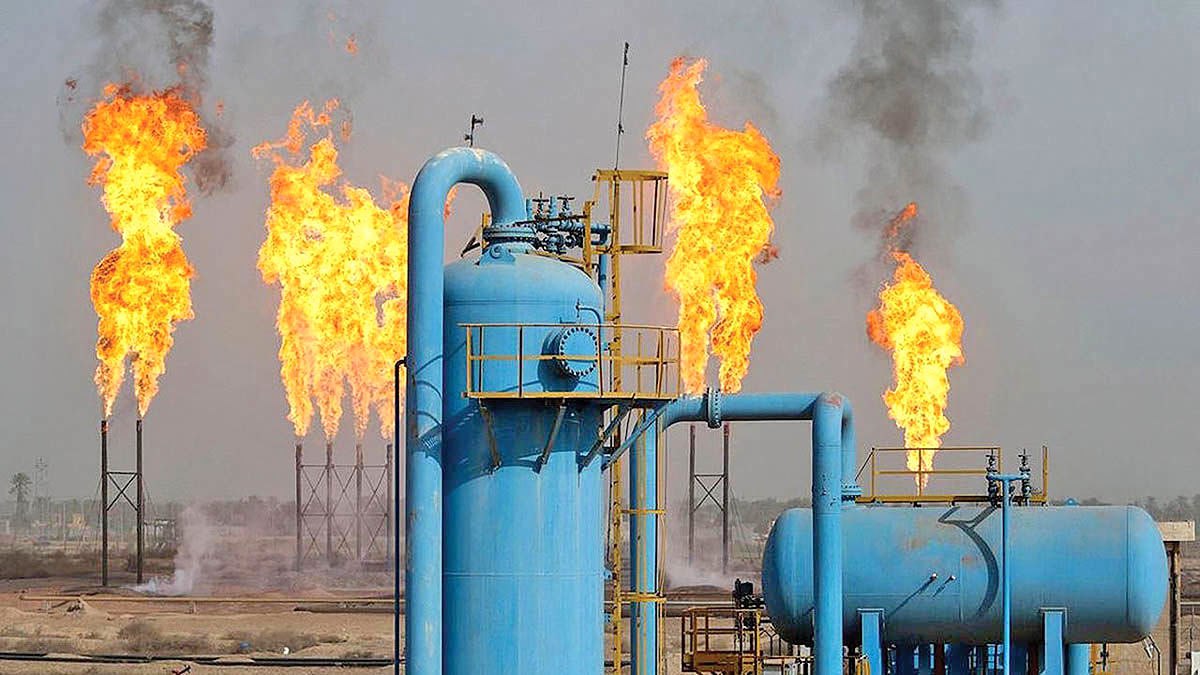
Iran’s oil minister has unveiled fresh data pointing to a tangible acceleration in the country’s efforts to curb gas flaring and strengthen domestic energy security, reporting that a total of around 16 million cubic meters per day of associated and flare gas has so far been collected nationwide.
Notably, more than 9 million cubic meters per day of this volume has been achieved under the current administration which took office in July 2024, a figure the minister described as “significant” both in scale and speed, reflecting a renewed policy focus on resource efficiency and environmental mitigation.
Speaking at the inauguration ceremony of the Tous gas field development project in Razavi Khorasan Province and the Dehloran gas pressure-boosting station in Ilam Province, Oil Minister Mohsen Paknejad said the Oil Ministry is fully aligned with the mandates set out in Iran’s Seventh Development Plan, Shana reported.
He stressed that parallel investment in gas field development and the systematic collection of associated and flare gas has now begun to translate into concrete infrastructure on the ground.
Tackling Gas Shortages in the Northeast
Paknejad highlighted structural vulnerabilities in Iran’s gas network in the northeastern regions, noting that Khangiran and Gonbadli are currently the only producing gas fields supplying much of the area’s demand.
During cold seasons, rising household consumption in northern and northeastern provinces puts severe pressure on the network, often leading to significant pressure drops at the end points of transmission lines—a long-standing weak spot in Iran’s gas system.
To address this imbalance, the ministry has prioritized the development of the Tous gas field, located about 100 kilometers from Mashhad, alongside the second phase of natural gas storage at the Shourijeh reservoir.
According to Paknejad, the commissioning of the subsurface and surface facilities at Tous will immediately add 1.5 million cubic meters per day to production, with another 1.5 million cubic meters per day expected next year, lifting total output to 3 million cubic meters per day.
Beyond sheer volumes, the strategic value of Tous lies in its location. “Our objective is not only to rely on Khangiran and Gonbadli,” Paknejad said, “but also to ensure southern gas can reliably reach the far ends of the transmission network, where pressure losses have historically been most acute.”
The Tous project represents a capital investment exceeding $120 million and has generated around 150 direct and 400 indirect jobs, largely filled by local and regional specialists.
The minister underscored that, since the start of the current administration, the twin goals of preventing national resource waste and reducing environmental pollution have placed flare gas recovery firmly at the top of the energy agenda.
Clarifying Associated Gas and Flare Gas
Paknejad drew a clear distinction between associated gas—produced during crude oil extraction—and flare gas, which is burned off at gas processing plants due to operational constraints.
While flare gas from refineries represents a relatively small share, associated gas volumes are substantial and economically recoverable.
Cumulatively, Iran now collects about 16 million cubic meters per day of these gases. Roughly 7 million cubic meters per day were achieved prior to the current administration, while 9 million cubic meters per day have been added over the past 15–16 months.
Before this period, about 5 million cubic meters per day came from associated gas recovery and 2 million cubic meters per day from flare gas at South Pars refineries.
During the current administration alone, approximately 7.2 million cubic meters per day of recovered gas has come from oil fields, with another 2 million cubic meters per day from South Pars refinery flares.
At the outset of the administration, daily flaring stood at 51.5 million cubic meters. Although 7.2 million cubic meters per day have since been identified and recovered, rising crude oil output—up by 225,000 barrels per day over the past 14 months—has naturally increased associated gas volumes, adding back roughly 5.7 million cubic meters per day to the system.
32 Flares to Be Shut Down
Summing up the figures, Paknejad said Iran currently burns around 50 million cubic meters per day of associated gas, plus an additional 5 million cubic meters per day of flare gas.
“These numbers are being stated on record,” he noted, “to serve as a transparent baseline for future planning.” Looking ahead, the ministry plans to finalize 12 flare and associated gas recovery contracts over the next 15 to 16 months, which are expected to collect an additional 8 to 9 million cubic meters per day and lead to the shutdown of 32 flares.
Many of these projects are classified as quick-win developments, with longer-term integration into permanent facilities to ensure sustained reductions in gas flaring.
Under the Seventh Development Plan, Iran is ultimately required to collect around 44 million cubic meters per day of associated and flare gas—a target that underscores both the scale of the challenge and the economic opportunity embedded in waste reduction.
Linking Upstream Recovery to Downstream Value
The inauguration of the Dehloran gas pressure-boosting station marks another milestone in this strategy.
The Dehloran and Danan oil fields have been producing for nearly five decades, with associated gas historically flared.
Built under an Engineering, Procurement, Construction, and Financing model with an investment of approximately $150 million, the new station will now capture this gas and supply about 1.8 million cubic meters per day of stable feedstock to the NGL 3100 plant.
This recovered gas will also support downstream projects, including the Dehloran petro-refining complex, strengthening value chains that extend well beyond upstream production.
Taken together, the latest figures suggest that Iran’s gas recovery program—long discussed but unevenly implemented—is gaining operational momentum.
While challenges remain, particularly as oil output rises, the combination of infrastructure rollout, contract-based recovery projects and regional balancing efforts signals a more systematic attempt to align economic efficiency with environmental responsibility in Iran’s energy sector.