
Hamid Mollazadeh
Whenever tensions flare between Iran and the United States, global energy markets shift their focus to a narrow but critical waterway: the Strait of Hormuz.
More than a maritime passage, Hormuz is the main artery of Persian Gulf energy exports and a strategic lever in Tehran’s geopolitical toolkit. An estimated $500 billion worth of crude and petroleum products flows through this corridor each year.
Any military maneuver, political warning or security incident in or around the strait is swiftly reflected in crude benchmarks. Even the perception of risk can lift prices, disrupt tanker schedules and inject volatility into financial markets already sensitive to supply shocks.
The recent deployment of the nuclear-powered aircraft carrier USS Gerald R. Ford to the region has intensified speculation about potential escalation. Washington has framed the move as a stabilizing presence. Tehran, meanwhile, has conducted military exercises and signaled that it retains the capacity to disrupt shipping if confronted militarily. The message is clear: Hormuz remains Iran’s most potent deterrent.
A Chokepoint With Global Consequences
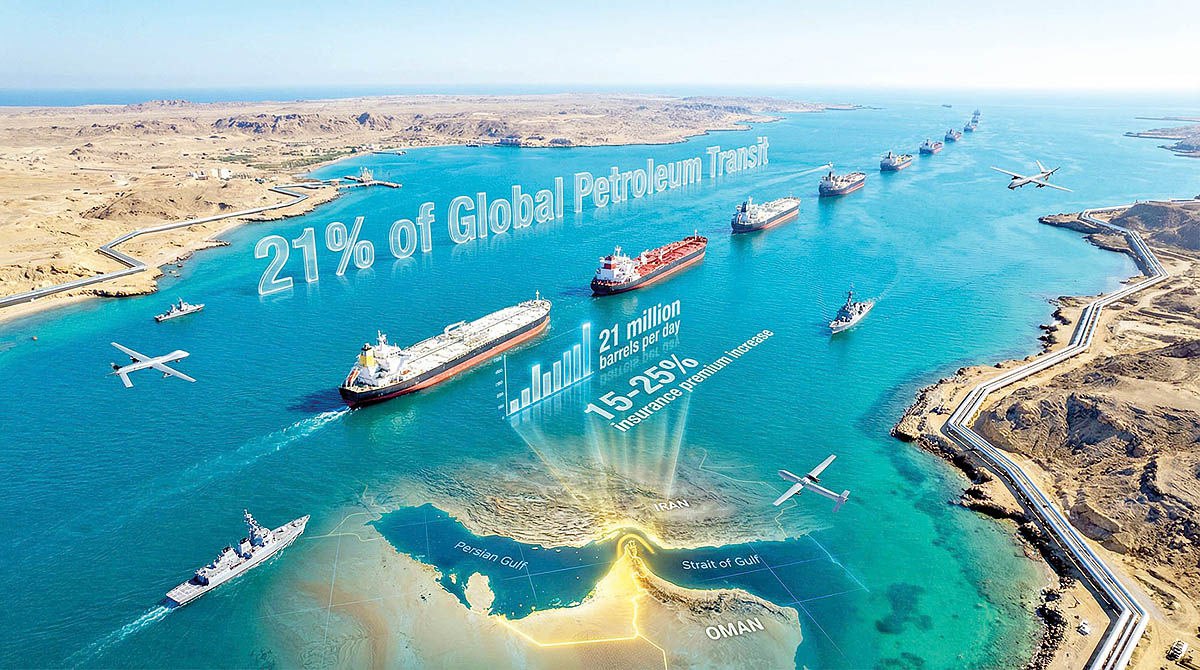
Geographically, the Strait lies between Iran to the north and Oman and the United Arab Emirates to the south. At its narrowest, it is just 33 kilometers wide, yet it accommodates the world’s largest crude tankers. It is the only sea passage linking Persian Gulf producers to international markets.
According to the US Energy Information Administration, roughly 20% of globally traded petroleum liquids transited Hormuz in 2024. The volumes originate primarily from Saudi Arabia, Iraq, the UAE, Kuwait, Qatar and Iran. For LNG, the Strait is equally indispensable, particularly for exports from Qatar, one of the world’s top suppliers.
Asia is the principal destination. China, India, Japan and South Korea collectively absorb the majority of crude flows through Hormuz. Their industrial output, power generation systems and transportation networks are deeply intertwined with the Persian Gulf energy stability.
Significant Leverage
International maritime law grants coastal states sovereignty over waters extending 12 nautical miles from their shores. In Hormuz’s narrowest channel, shipping lanes run through Iranian and Omani territorial waters—a geographic reality that provides Tehran with significant strategic leverage.
Iran’s naval doctrine emphasizes asymmetric capabilities: fast attack craft equipped with anti-ship missiles, submarines and the potential deployment of naval mines. Such tools are designed not to dominate conventional naval warfare, but to complicate it—raising the cost and risk of any confrontation.
While a full closure of the Strait would also harm Iran’s own exports, even limited harassment or temporary disruption could have outsized psychological and financial effects. Markets do not require an actual blockade to react; credible threats alone can widen risk premiums and drive speculative buying.
The Price Shock Scenario
Energy analysts warn that a serious disruption in Hormuz would produce an immediate spike in oil prices. Most of OPEC plus spare production capacity is concentrated in Persian Gulf states whose exports depend on this passage. Alternative pipeline routes in Saudi Arabia and the UAE offer partial bypass options, but their capacity is insufficient to replace total seaborne flows.
Iran itself exports roughly 1.5 million barrels per day, primarily to China, much of it shipped through Hormuz. A sustained disruption could therefore remove substantial volumes from the market at a time when global spare capacity is already limited.
In such a scenario, crude prices could quickly surge toward or beyond the $100-per-barrel threshold. For major Asian importers, the consequences would include higher fuel costs, widening trade deficits and renewed inflationary pressure. For Europe, already sensitive to energy security concerns, the ripple effects would be immediate.
A Systemic Risk Point
The Strait of Hormuz is not merely a regional flashpoint. It is where geopolitics intersects directly with the global economy. In periods of relative calm, its narrow shipping lanes function as an efficient conduit for energy trade. In times of confrontation, they become a pressure valve for strategic messaging and market anxiety.
Historical precedent suggests that all sides have strong incentives to avoid a prolonged closure. Yet as tensions between Tehran and Washington ebb and flow, Hormuz remains a constant variable—a reminder that a strip of water less than 40 kilometers wide holds disproportionate influence over global energy security.