
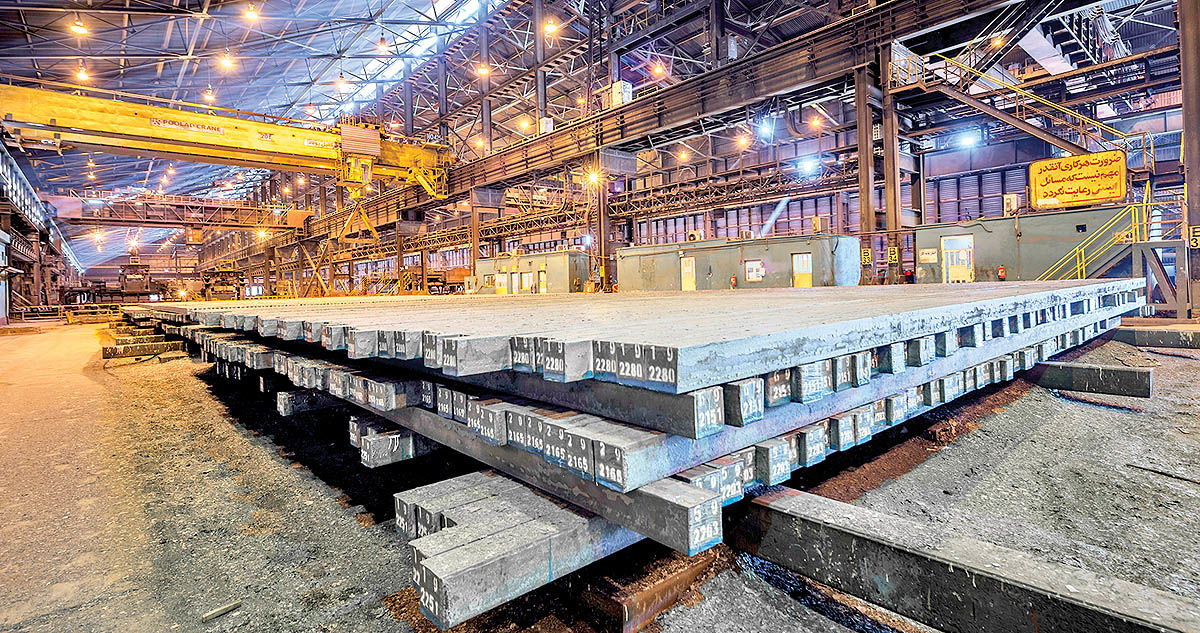
Iran’s steel industry has entered one of its most complex periods in recent years after recent US and Israeli strikes damaged key production sites, including major complexes such as Khuzestan Steel Company and Mobarakeh Steel Company. While the full scale of the damage remains unclear, early signs point to production disruptions, rising uncertainty and growing pressure across the supply chain.
The shock goes beyond physical damage. It has exposed how tightly production depends on logistics, policy coordination and access to raw materials. In this environment, maintaining output is no longer just a technical challenge—it is a test of decision-making speed and crisis management. How authorities and firms respond could determine whether the current disruption remains temporary or evolves into a deeper structural problem.
Bahador Ahramian, a board member of the Iranian Steel Producers Association, said in an interview that “due to security considerations, no precise figures about the extent of damages have been officially released, and companies prefer not to disclose technical details publicly.” However, he added that “based on informal estimates and available evidence, some key units in the steel production chain appear to have suffered significant damage.”
Referring to one of the country’s largest steel complexes, he noted that “parts of the direct reduction and steelmaking units have reportedly been damaged,” which could affect billet and flat steel production in the short term. According to Ahramian, if current conditions persist, “flat steel output may face limitations over the next three to six months,” although gradual recovery is possible through alternative arrangements.
Ripple Effects
The importance of this disruption lies in its ripple effects. Large steel producers supply a wide range of downstream industries, from automotive and home appliances to construction and metal products. “Any disruption in this complex directly affects hundreds or even thousands of downstream units,” Ahramian said. “If raw material shortages continue, these industries will face reduced output and rising costs.”
Export commitments add another layer of complexity. Ahramian explained that “part of the production had already been committed under export contracts before the crisis, so an immediate halt is not feasible.” However, he warned that “if restrictions intensify, exports may be reduced or suspended to prioritize domestic supply.” While such a move could stabilize the local market in the short term, it requires careful coordination at the policy level.
One immediate solution is to increase imports of flat steel. Ahramian pointed to countries such as Russia, Kazakhstan and China as potential suppliers, noting that “there is excess capacity in the global market, especially in flat products, and technically there are no serious limitations for sourcing these materials.” However, he stressed that “this option depends on facilitating import procedures and quickly reducing barriers such as tariffs, currency restrictions and administrative bureaucracy.”
Delays in this area could worsen the situation. “Any delay in securing imports can lead to broader disruptions in the production chain,” he said.
A Brief Buffer
In the short term, inventory levels offer some relief. Many firms had increased raw material stocks ahead of the Nowruz holidays, which provides a temporary buffer. “This has allowed some industries to meet their needs for a limited period and creates a window for planning imports and market adjustments,” Ahramian noted. However, he cautioned that these reserves are limited and may only last until late April or early May.
Beyond supply concerns, logistical and trade challenges are also emerging. Traditional trade routes, particularly through Persian Gulf countries, may face disruptions or changes. This uncertainty highlights the need to explore alternative supply corridors and diversify trade channels.
Despite the pressure, companies appear committed to maintaining employment. According to Ahramian, managers of major steel firms have indicated that there are no plans for layoffs, emphasizing efforts to avoid broader social consequences.
Another critical issue is transparency. Hessameddin Farhadinasab, vice chairman of the Mining Commission at Isfahan Chamber of Commerce, stressed that access to reliable information is essential in crisis conditions. “If the reality of the situation is not accepted, proper decision-making becomes impossible,” he said, adding that “even in wartime, many countries prioritize providing accurate information to reduce uncertainty for economic actors.”
He criticized unnecessary secrecy, noting that “some undisclosed information is not inherently security-related and could be shared to help businesses plan.” According to him, “industrial operators need information— even limited— more than ever to manage risks and reduce uncertainty. Silence in such conditions leads to inaction and weakens decision-making.”
Farhadinasab also acknowledged that in some cases, “important parts of industrial complexes have been damaged and may not be repairable in the short term.” Yet, he argued that sharing such realities “is not a threat but helps economic actors identify alternative paths more quickly.”
Broader Concern
The broader concern is how the shock spreads along the mining and steel value chain. From extraction to final products, each segment depends on the others. A disruption in one link can quickly affect the entire system, leading to imbalances in supply and demand, rising costs and declining efficiency.
As uncertainty grows, firms tend to shift their focus from expansion to risk management—prioritizing inventory control, short-term sourcing and liquidity preservation. While this approach is rational in the short run, it could reduce competitiveness over time and slow technological progress.
In mining, reliance on transport infrastructure, energy supply and export markets further increase vulnerability. Even units that remain physically intact may face reduced capacity due to disruptions in input supply or sales channels.
In this context, policymakers play a decisive role. By easing trade barriers, enabling targeted imports, improving transparency and ensuring access to inputs, they can prevent the current shock from deepening. Otherwise, what began as a temporary disruption could evolve into a structural challenge for Iran’s steel industry.