
The global oil market is once again navigating a high-stakes geopolitical shock, as escalating US pressure on Iran and severe constraints around the Strait of Hormuz disrupt both flows and expectations. Reports from international trackers suggest Iran’s onshore storage capacity has fallen to critically low levels, leaving only a narrow window—estimated at a few weeks—before production adjustments become unavoidable. In practical terms, this raises the likelihood that Iranian output could decline sharply by mid-May, potentially dropping toward 1.5 million barrels per day if export bottlenecks persist.
What makes the current episode particularly complex is the simultaneity of supply disruptions. Regional producers including Saudi Arabia, Iraq, Kuwait and the UAE have also faced constraints linked to the broader conflict environment. This synchronized pressure has tightened global supply and kept prices elevated, even as demand signals remain mixed. Analysts warn that if storage limits are breached, Iran may be forced into temporary shut-ins—not due to reservoir management, but logistical constraints.
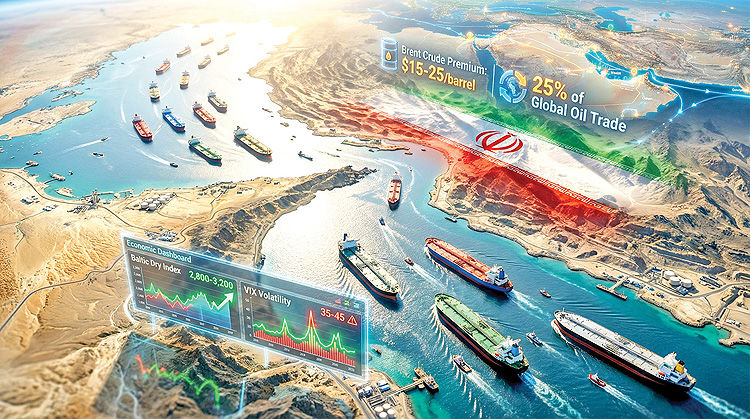
Satellite imagery and maritime intelligence point to an unusual buildup of Iranian tankers near the port of Chabahar in the Gulf of Oman. While technically outside the Persian Gulf, the area sits close to the effective perimeter of US naval enforcement. Several supertankers, along with smaller vessels, appear to be idling—loaded but unable to discharge. This suggests that Iran continues to produce and load crude, yet the physical flow to end markets has slowed dramatically. Traffic through the Strait of Hormuz, a critical artery for global oil trade, has reportedly dropped close to zero, amplifying the risk of supply fragmentation.
Temporary Release Valve
Floating storage has thus emerged as a temporary release valve. Estimates indicate that roughly 155 million barrels of Iranian crude are currently in transit or held offshore. This buffer provides short-term flexibility, allowing Tehran to sustain production despite export constraints. However, floating storage is inherently limited. It raises costs, complicates logistics and cannot substitute for stable market access indefinitely.
At the same time, Washington has intensified enforcement beyond the region, including tanker inspections in the Indian Ocean and sanctions targeting key buyers. One notable move involved penalizing a major independent Chinese refinery, signaling that secondary sanctions may increasingly shape trade behavior. In response, Iran has expanded the use of older vessels and so-called “shadow fleet” tactics, reactivating tankers and obscuring cargo origins to sustain exports.
China remains the pivotal demand anchor, but even there, signals are mixed. Independent refiners—known as teapots—continue to absorb the bulk of Iranian crude, yet their appetite is weakening. Refining margins in China have fallen to their lowest levels in about a year, squeezed by rising crude costs and controlled domestic fuel prices. This divergence has eroded profitability and curbed incentives to increase imports, even when discounted barrels are available.
Adding to the pressure, Iranian crude—once consistently offered at a discount—has recently approached parity with, or even traded at a premium to, benchmark prices like Brent. This shift reduces its economic attractiveness, particularly for cost-sensitive buyers. As a result, demand dynamics are no longer solely driven by geopolitics, but increasingly by refining economics.
Beijing’s policy stance further complicates the outlook. On one hand, authorities have encouraged refiners to maintain output and have accelerated import quota allocations, indirectly supporting crude purchases. On the other hand, weak margins are forcing companies to act cautiously. This tension between policy support and market reality has slowed the growth of Iranian oil imports.
Dual Squeeze
In the near term, floating inventories act as a shock absorber, potentially covering more than two months of China’s current import needs. Yet beyond that horizon, the outlook hinges on geopolitics. If constraints around Hormuz persist and enforcement tightens, Iran’s ability to sustain exports will face mounting strain. The oil market, in turn, remains highly sensitive: any shift in the regional balance—military, logistical or diplomatic—could rapidly reverberate through prices and supply chains.
In essence, Iran’s oil sector is now caught in a dual squeeze—restricted supply routes and softening demand signals. The resilience of this system will depend not only on Tehran’s logistical adaptations, but on how long the geopolitical pressure cycle endures.