
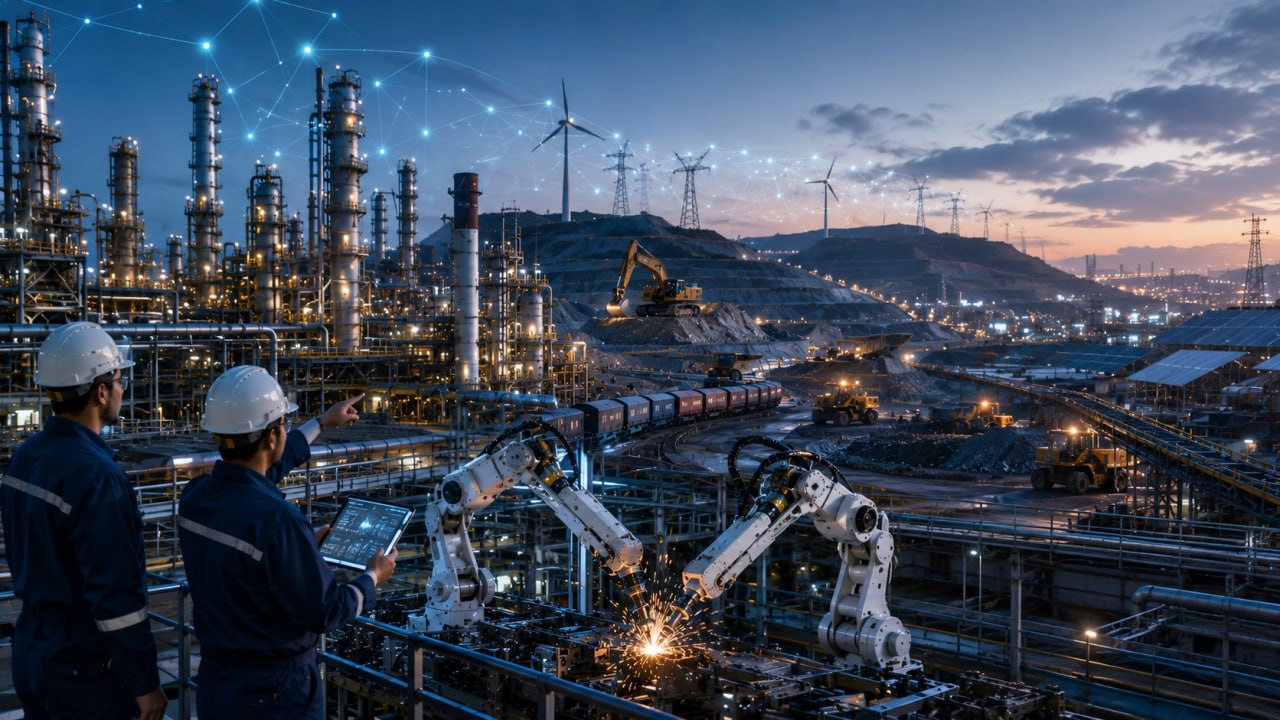
Every major industrial transformation has rewarded countries that embraced change early while leaving late adopters struggling to catch up. Steam engines powered the First Industrial Revolution. Electricity reshaped manufacturing during the second. Computers and automation defined the third, while digital connectivity transformed the global economy during the fourth.
Today, the world is entering yet another industrial revolution—one driven not by machines alone, but by intelligence itself. Artificial Intelligence is rapidly becoming the most valuable production asset of the twenty-first century. For Iran's industrial sector, this is no longer a discussion about future technology. It is a question of economic survival and international competitiveness.
Understanding Industrial AI
Public attention has largely focused on generative AI platforms capable of producing text, images, and software code. While these applications have transformed office work, they represent only a small fraction of AI's economic potential.
The real industrial revolution is taking place inside factories, mines, refineries, logistics networks, power plants, and supply chains. Industrial AI enables manufacturers to predict equipment failures before they occur, optimize production schedules in real time, reduce energy consumption, automate quality inspection through computer vision, forecast demand, optimize inventories, and improve maintenance planning.
These capabilities directly increase productivity while lowering operational costs. Around the world, companies implementing AI-driven manufacturing systems are already achieving measurable improvements in efficiency, quality, workplace safety, and profitability.
Iran's Competitive Challenge
Iranian manufacturers operate under unusually difficult circumstances. Economic sanctions, limited access to advanced technology, aging industrial infrastructure, energy shortages, inflation, supply-chain disruptions, and volatile exchange rates have collectively reduced competitiveness across many industries.
Under these conditions, increasing productivity is no longer simply desirable—it is essential. Artificial Intelligence offers one of the few technologies capable of improving efficiency without requiring proportional increases in labor, capital investment, or raw material consumption. For an economy facing structural constraints, productivity growth may represent the most sustainable source of long-term economic expansion.
AI Is Not Replacing People
One of the greatest misconceptions surrounding Artificial Intelligence is the fear that it will eliminate human employment. History suggests otherwise. Every technological revolution has changed the nature of work rather than eliminating the need for human expertise.
AI does not replace experienced engineers, technicians, managers, or operators. Instead, it amplifies their capabilities. The future workforce will not consist of humans competing against machines. It will consist of professionals who know how to collaborate with intelligent systems outperforming those who do not.
The competitive gap will emerge not between companies that use people and companies that use AI—but between companies whose people effectively use AI and those whose people do not.
Digital Transformation Must Come First
Artificial Intelligence cannot compensate for weak organizational foundations. Successful implementation requires reliable operational data, integrated information systems, digital infrastructure, cybersecurity, and clear business objectives.
Without these prerequisites, AI becomes little more than an expensive experiment. Industrial digitalization must therefore precede large-scale AI deployment. Companies investing today in data collection, process standardization, and digital management systems are simultaneously preparing themselves for tomorrow's AI economy.
SMEs Have the Most to Gain
Contrary to popular perception, Artificial Intelligence is not reserved for multinational corporations. Small and medium-sized enterprises (SMEs), which form the backbone of Iran's industrial economy, may actually benefit the most. Many AI applications require relatively modest investment while generating rapid returns.
Examples include:
• Predictive equipment maintenance
• AI-assisted sales forecasting
• Intelligent inventory management
• Financial risk analysis
• Customer service automation
• Procurement optimization
• Document management
• Production scheduling
These practical solutions often pay for themselves long before companies begin investing in more sophisticated AI systems.
Energy Efficiency: Iran's Greatest Opportunity
One area deserves particular attention. Iran's industrial sector faces recurring electricity shortages, natural gas constraints, and increasing energy costs. Artificial Intelligence has become one of the world's most effective tools for industrial energy optimization.
AI systems continuously analyze production conditions, electricity consumption, equipment performance, and operational efficiency to reduce waste while maintaining output. For an energy-intensive economy like Iran, AI should not merely be viewed as a digital technology—it should also be considered an energy policy.
Improving industrial energy efficiency through intelligent systems could significantly enhance national productivity while reducing pressure on the country's energy infrastructure.
A National Strategy Is Essential
Industrial AI cannot expand through isolated corporate initiatives alone. It requires coordinated national policy. Government, industry, universities, technology companies, and financial institutions must work together to create an ecosystem that encourages innovation.
Such a strategy should prioritize:
• Digital infrastructure development
• Industrial data governance
• Support for AI startups
• Workforce reskilling
• University-industry collaboration
• Financial incentives for industrial innovation
• Cybersecurity standards
• Responsible AI regulation
Universities must also evolve beyond teaching theoretical AI concepts and focus on solving practical industrial challenges faced by manufacturers.
The Race Has Already Begun
The countries leading today's industrial transformation understand a simple reality. Future competitiveness will depend less on access to inexpensive labor or abundant natural resources and far more on the ability to generate data, extract intelligence, automate decisions, and innovate continuously.
Artificial Intelligence has become a new factor of production—alongside capital, labor, and energy. Those who master it will define tomorrow's industrial leaders. Those who delay will spend years attempting to close an ever-widening technological gap.
The question is no longer whether Artificial Intelligence will transform manufacturing. That transformation is already underway. The real question is whether Iranian industry will become an active participant in this new industrial era—or remain a consumer of technologies developed elsewhere.
The answer will shape not only the future of Iranian manufacturing but also the country's productivity, investment climate, export competitiveness, technological independence, and long-term economic resilience.
Artificial Intelligence is not simply another technological trend. It may well represent the greatest opportunity for Iran's industrial sector to leap forward in productivity, sustainability, and global competitiveness since the advent of modern manufacturing itself.
The decisions made today will determine whether this opportunity becomes the foundation of a new era of industrial growth—or another revolution observed from the sidelines.