
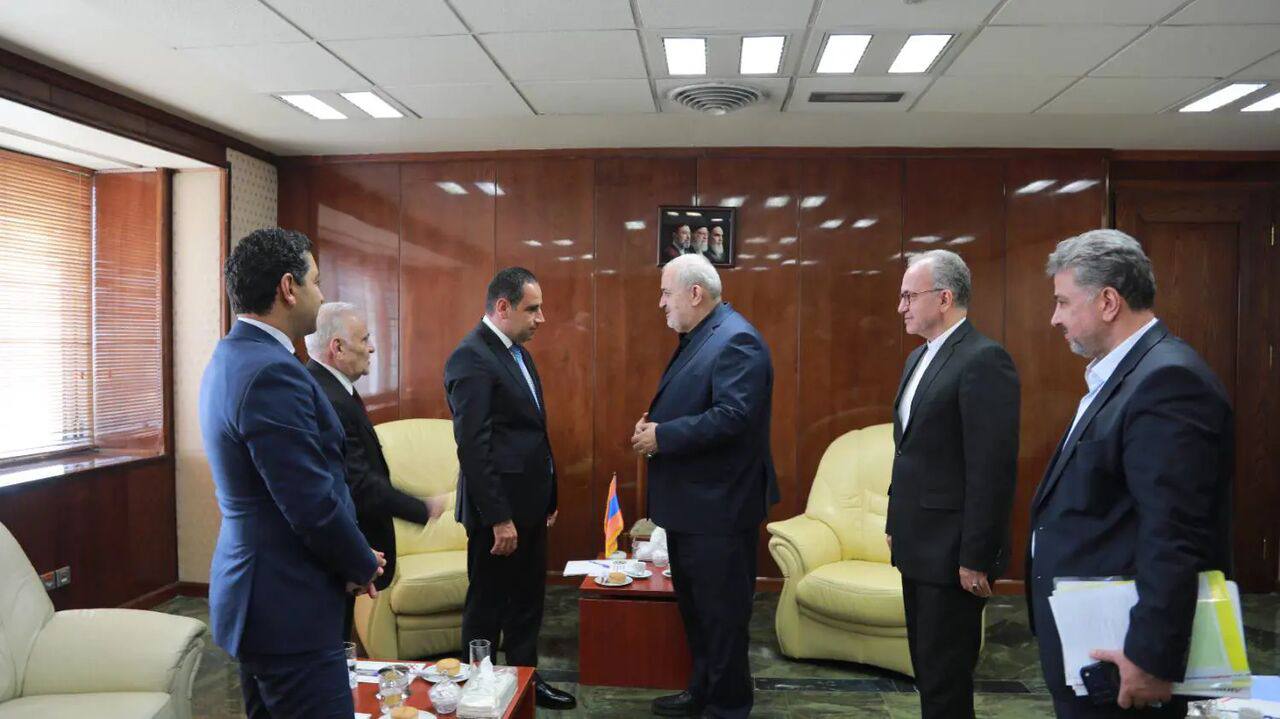
In a meeting between Iran's Minister of Energy and Armenia's Minister of Territorial Administration and Infrastructure, both sides emphasized accelerating the implementation of the third power transmission line project, constructing the Meghri hydroelectric power plant, and developing the Iran-Armenia-Georgia-Russia power corridors.
According to IRNA from the Ministry of Energy, Abbas Aliabadi, Minister of Energy of Iran, and Davit Khudatyan, Minister of Territorial Administration and Infrastructure of Armenia, held a bilateral meeting to review the latest status of joint cooperation in the energy and electricity sectors.
During this meeting, both sides emphasized accelerating the implementation and completion of the 12-year-old third power transmission line project, and it was decided that cooperation with an Iranian company would continue by expediting the approval and submission of progress reports. The company has also pledged to install the towers in sections 5 and 6 within the next month.
Regarding the third power transmission line project, both sides emphasized the need to secure liquidity for cabling, which is the main bottleneck of this project, so that the line can be energized with a capacity of 230 kV.
In this meeting, the Minister of Energy raised the request for constructing the Meghri run-of-the-river hydroelectric plant, and the Armenian side, referring to previous agreements, announced its readiness to cooperate in building this plant. It was also announced that an Omani company has expressed its readiness to finance and implement the Meghri plant project.
Additionally, the issue of the Iran-Armenia-Georgia-Russia power corridors was another topic discussed in this meeting. The Iranian side, referring to conducted studies, emphasized the technical and economic justification for electricity exchange with Armenia and Georgia along this corridor, and announced its readiness for the power transmission line between Armenia and Georgia to be constructed by Iranian companies.
In another part of the meeting, the Ministry of Energy also supported holding the upcoming session of the Aras River pollution working group, given the track record of positive bilateral cooperation.
On the sidelines of the meeting, the Minister of Energy stated that Iran and Armenia are neighboring and brotherly countries with a long history of relations and joint cooperation, and pointed to the development of bilateral cooperation between the countries, saying: Both countries have always strived to develop these relations.
The purpose of the visit of Armenia's Minister of Territorial Administration and Infrastructure is to follow up on and complete some unfinished projects, as well as to initiate new joint projects. I believe this visit can be very important and influential in this regard. One of the most important projects for us is connecting Iran's power grid to the northern countries, of which Armenia is one of the main links in this route. Alongside Armenia, other countries are also involved in this plan, and we are examining ways to operationalize the Iran-Armenia-Georgia-Russia connection project.
Regarding other objectives of the joint meeting between the two countries, the Minister of Energy stated: Another important issue is the development of energy cooperation. For years, Iran has been exporting gas to Armenia and receiving electricity in return. The development of this cooperation has been on the agenda for some time, and it requires the construction of a new transmission line. This project is currently being implemented, and during this visit, negotiations were held to accelerate its progress so that it yields results more quickly. Another topic of discussion was the joint Aras River project. This river has good potential for hydroelectric power generation, and it is possible to construct a run-of-the-river power plant with a capacity of around 200 MW. Preliminary discussions have already been held on this matter.
Of course, the studies for this project have been fully completed previously, and now decisions need to be made regarding its financing and implementation phases.
Aliabadi also reported on discussions regarding the environmental issues of the Aras River and emphasized: Both sides are interested in pursuing this issue. Of course, the direct responsible party for this area on the other side is someone else, but they announced that they would convey the matter to the relevant authority so that it could be examined in future meetings. Domestically, the process of increasing power generation capacity continues. As you know, this year, about 9,000 megawatts have been added to the country's power generation capacity. Armenia is also pursuing its own development plans. Currently, the most important joint project being pursued between the two countries is the Aras River hydroelectric project, for which negotiations began earlier, studies have been completed, and it is now in the phase of continuing negotiations and making decisions for its implementation.
Grid Integration
The Armenian minister, for his part, stated that the cooperation between Iran and Armenia is at a very high level.
In the energy sector, the exchange of gas and electricity between the two countries has been ongoing for years, and the Republic of Armenia has the capacity to export electricity to Iran throughout the year and receive gas in return. In today's meeting, this issue was also discussed with the respected Minister of Iran.
Additionally, the capacities for developing bilateral cooperation and connecting the energy infrastructure of the two countries were discussed. One of the most important joint projects is the 400 kV transmission line, which is currently under implementation. Of course, there are some issues and obstacles along the way of this project, and we discussed and consulted about them today, he added, saying: We hope that with the joint cooperation and follow-up of both sides, this project will be commissioned by the end of the year.