
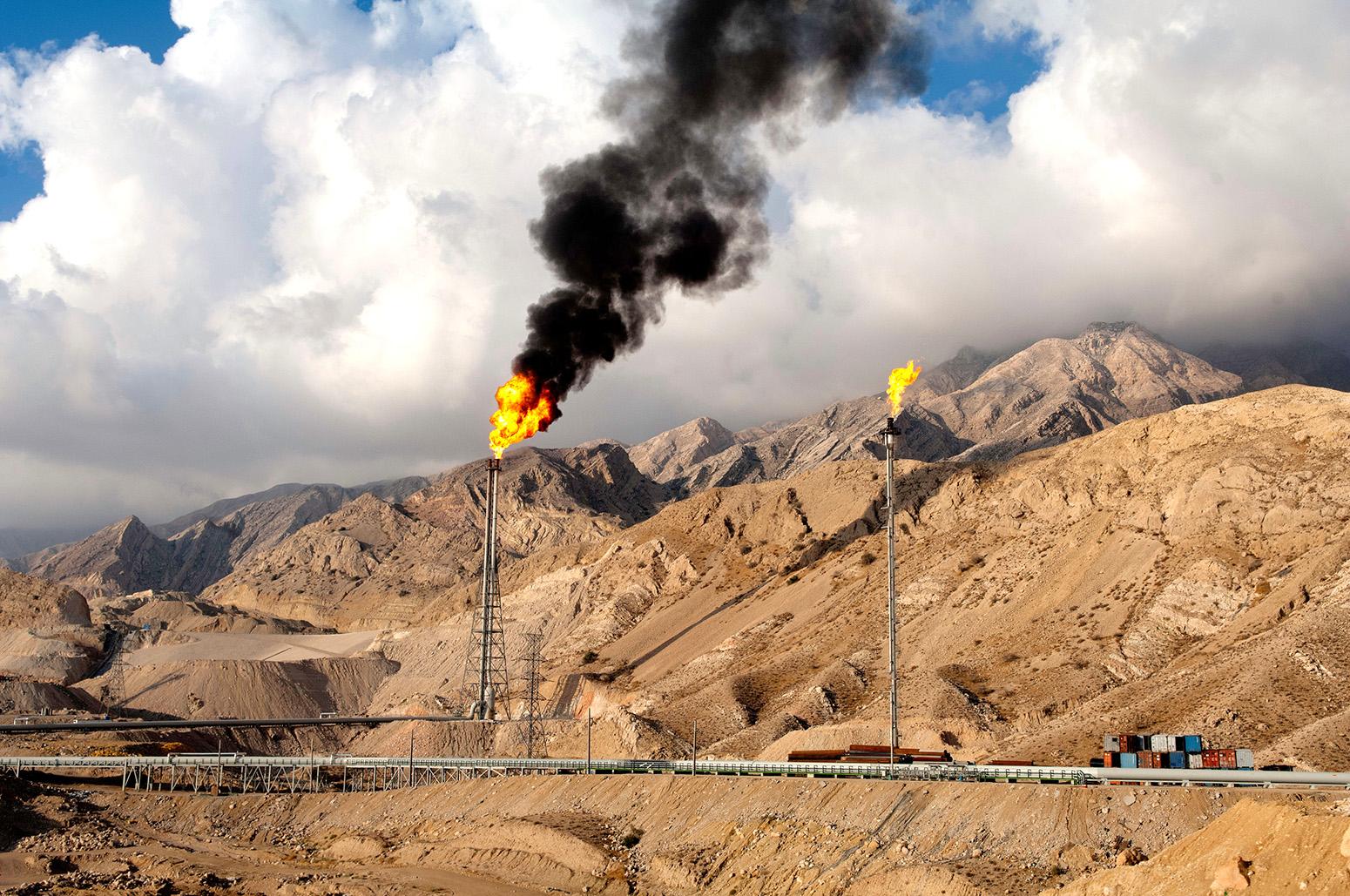
Iran has more than doubled its capacity for collecting associated petroleum gases over the past year, yet vast volumes of gas continue to be burned off at oil fields across the country—releasing harmful pollutants and wasting a resource that could otherwise fuel industries and power plants.
According to official data, flare gas collection in Iran's oil sector has reached over 16 million cubic meters per day, up from roughly 7 million cubic meters per day before the current administration took office. The increase has been achieved through the commissioning of new processing units and the implementation of short-term projects. However, environmental advocates caution that these gains remain modest compared to the scale of the problem.
Currently, about 80 million cubic meters of associated gas are produced daily alongside crude oil. Of this, between 40 and 50 million cubic meters are still being flared—a practice that, beyond wasting energy, releases carbon dioxide, methane, and other pollutants into the atmosphere. Flaring contributes to local air quality deterioration and poses health risks to communities living near oil-producing regions.
The government has set a target to reduce flaring to approximately 35 million cubic meters per day by the end of the current administration's term. Achieving this would mark a significant environmental achievement, but officials acknowledge that the path forward is steep. With crude oil production rising, associated gas output is also increasing, meaning that without simultaneous investment in processing and transmission infrastructure, flaring volumes could climb again.
To address this, the National Iranian Oil Company has pursued a dual-track strategy. Short-term projects—designed to be completed within 18 to 30 months—have brought some flare gases into the value chain by assigning them to private sector investors and buyers. Recent operational projects include the Marun 5 unit, the Dehloran gas booster station, and a modification project at the Haftkel gas injection station—the latter enabling flare gas collection from that region after many years of burning.
Alongside these, five long-term projects are underway to create sustainable processing capacity, including flare gas collection contracts in East Karun and the construction of NGL 3200 in West Karun, NGL 3100 in Dehloran, and Kharg NGL for the Bahregan and Kharg regions. The commissioning of NGL 3200 in 2023 and NGL 3100 in August of this year has already brought a portion of the projected capacity online.
Reza Khilaei, Director of Oil and Gas Production Supervision at the National Iranian Oil Company, has stated that the sustainable capacity projected in long-term plans is about 1.9 billion cubic feet per day—roughly equivalent to the output of one phase of the South Pars gas field. This capacity, he noted, would not only prevent new flaring but also provide more stable feedstock for downstream industries and petrochemicals.
Yet the scale of investment required is enormous. Officials estimate that collecting the bulk of flare gases will require about $6 billion, of which approximately $4.5 billion has so far been committed by the private sector. More than 90 flare points are spread across seven provinces, many of them producing sour gas that requires specialized sweetening equipment—a challenge compounded by foreign exchange restrictions and complex procurement procedures.
The main model for implementation involves selling flare gas to private investors, who process it and generate revenue from extracted liquids and gas products. To make projects more attractive, base gas prices in tenders are adjusted according to gas composition, liquid content, and transmission costs. In some remote or difficult-to-access locations, the base price has been reduced to zero to incentivize participation.
Of the more than 90 flare points, about 30 have so far been assigned to the private sector.
The remaining points depend on investor interest, finalization of negotiations, permit approvals, and financing. The Oil Ministry has also invited petrochemical companies to enter these projects, as their involvement could stabilize their feedstock supply during cold months.
The Seventh National Development Plan mandates the annual collection of 16 billion cubic meters of flare gas—14 billion cubic meters under the jurisdiction of the National Iranian Oil Company and 2 billion under the National Iranian Gas Company. To improve monitoring, visual equipment and online systems are being installed to track project progress through a national observatory.
For environmentalists and public health experts, the flaring reduction target is a welcome step, but the pace remains a concern. With billions still needed and complex technical and financial obstacles ahead, the question is whether Iran can sustain momentum—or whether the flares will continue to burn well into the next decade.