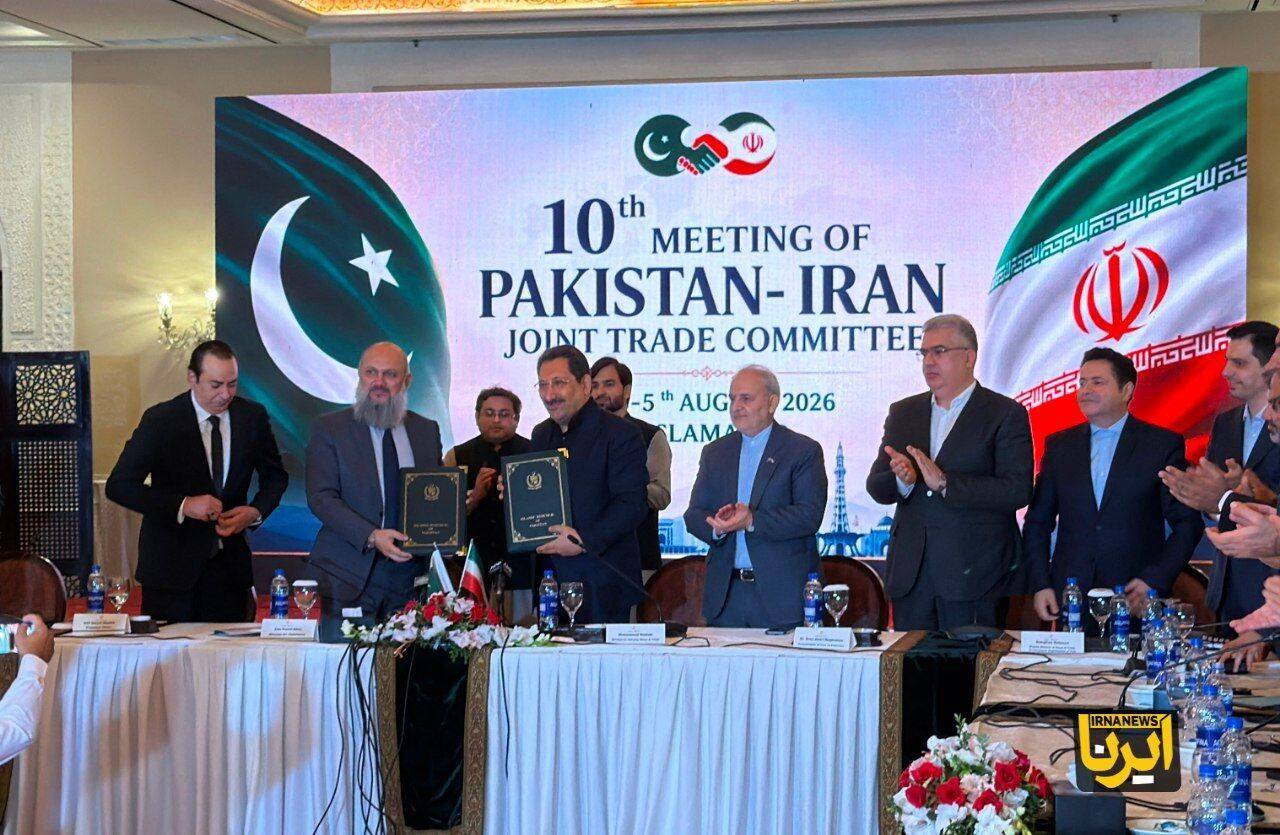
Iran and Pakistan have signed a memorandum of understanding to expand trade cooperation, marking a key milestone in their economic relations. The agreement was finalized during the 10th session of the Joint Trade Committee in Islamabad, with both sides pledging to work toward the $10 billion bilateral trade target and eventually signing a free trade agreement.
The signing ceremony was attended by Iran's Minister of Industry, Mining and Trade, Seyyed Mohammad Atabak, and Pakistan's Minister of Commerce, Jam Kamal Khan. The MOU covers a broad spectrum of cooperation, including joint border development, maritime transport, free trade zone establishment, barter trade, and coordinated efforts toward a formal free trade pact.
'No Limits' on Trade, Says Iran
Minister Atabak described the negotiations as productive and said the talks over the past two days focused on boosting trade volumes and removing existing hurdles.
"We had good negotiations with Pakistani officials. Everyone emphasized the expansion of interactions between the two nations," Atabak said. He added that in some areas, facilities and obstacle removal are needed, and Pakistan has agreed to pursue new follow-ups.
The Iranian minister stressed that Tehran places no restrictions on expanding trade with Islamabad and called on the private sectors of both countries to play an active role. "The principled policy of Iran is to expand cooperation with neighbors and, where necessary, supply its needed goods from neighboring countries," he said.
Key provisions of the MOU include activating border regions, increasing private sector participation, exchanging technical delegations, and fast-tracking implementation of existing bilateral agreements. Officials from both ministries will now work on execution mechanisms.
Private Sector Meeting Highlights Untapped Potential
On the sidelines, a meeting was held at the Federation of Pakistan Chambers of Commerce and Industry (FPCCI), hosted by President Atif Ikram Sheikh and senior officials from chambers across Pakistan.
Sheikh described Iran and Pakistan as centuries-old partners that have supported each other through difficult times. He noted that Pakistan's government, business community, and people stood by Iran during recent regional crises.
Despite sharing long borders, Sheikh said, the two countries have not fully utilized their mutual trade capacities. "This is a serious demand of economic activists and traders of Iran and Pakistan, and we must take more steps to benefit from each other's capabilities," he said.
Minister Atabak welcomed the engagement, saying such high-level interactions are necessary for resolving issues quickly and sustainably. "Pakistan and Iran are not only neighbors, but their relations are rooted in history, religion, and social cooperation," he said.
A separate MOU was also signed between the Iran Chamber of Commerce and Industries and FPCCI to further institutionalize private-sector collaboration.
TPO Head Outlines Iran's Strategic Offer
Mohammad Ali Dehghan Dehnavi, Deputy Minister and Head of Iran's Trade Promotion Organization (TPO), addressed traders from both sides and outlined Iran's strategic vision.
Dehnavi said Pakistan is a top priority for Iran in its policy of expanding ties with neighbors. He highlighted Iran's population of 90 million, rich energy and mining resources, industrial capacity, knowledge-based products, and strategic location with access to major rail, road, and maritime networks.
Iran's ports on the Caspian Sea, the Persian Gulf, and the Indian Ocean—particularly Chabahar—serve as vital connectors, he said, adding that Tehran is also open to using Karachi and Gwadar ports to expand international trade.
Iran has developed extensive free trade and special economic zones, including Chabahar in the south, Amirabad and Anzali in the north, and Aras in East Azerbaijan, he noted.
"Pakistan can be a good market for Iranian goods and also play a role in supplying basic commodities and raw materials for Iran. Pakistani ports can serve as a re-export hub for Iranian goods to other countries," Dehnavi said.
$10 Billion Goal by 2030
Dehnavi said bilateral trade in 2025 stood at around $3 billion, and based on directives from both countries' leadership, the target is to reach $10 billion by 2030.
"To achieve this goal, the efforts of traders and the support of both governments are more necessary than ever," he said.
He called for resolving transportation and customs issues, removing banking and financial transfer barriers, and strengthening border infrastructure. Participation in exhibitions and exchange of trade delegations would also help bring the private sectors closer, he added.
High-Level Diplomatic Agenda
Minister Atabak's visit includes meetings with Pakistan's ministers of communications and petroleum, as well as a scheduled audience with Prime Minister Shehbaz Sharif. The Iranian delegation includes representatives from major companies in oil, gas, petrochemicals, food, agriculture, transport, shipping, and knowledge-based industries, all ready to negotiate with Pakistani counterparts.
With the MOU now in place and implementation mechanisms being developed, both countries appear set to turn their longstanding ties into concrete economic benefits for nearly 300 million people across their shared borders.