
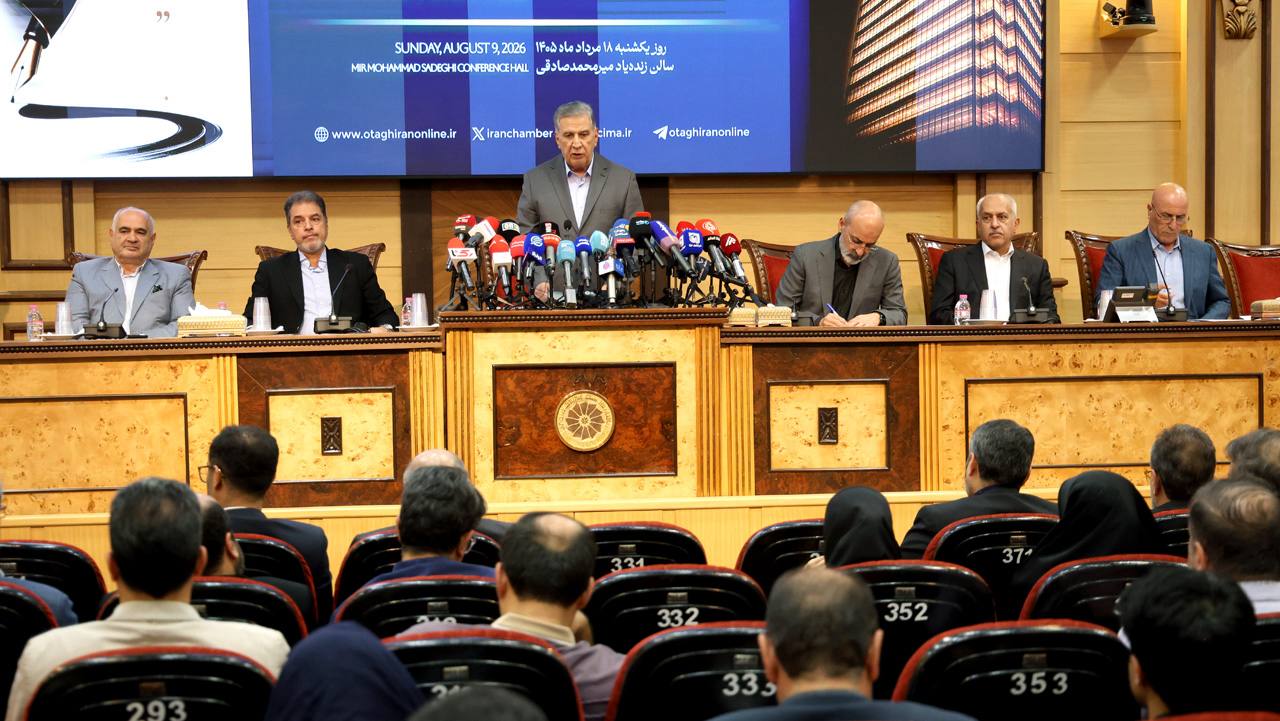
As Iran navigates a delicate post-war landscape, the country's private sector is positioning itself as a stabilizing force capable of turning any potential diplomatic breakthrough into lasting economic reality. That was the central message from Samad Hassanzadeh, head of the Iran Chamber of Commerce, Industries, Mines and Agriculture (ICCIMA), during a wide-ranging meeting with journalists in Tehran on Sunday.
Speaking on the occasion of Journalist's Day, Hassanzadeh made clear that the private sector is not merely a passive beneficiary of international agreements but an active pillar for their sustainability. "The deeper the healthy, balanced economic ties and shared interests among countries become," he said, "the higher the cost of returning to tension will be."
The ICCIMA chief framed the economy as a frontline for defending national interests, warning that adversarial forces have made weakening Iran's economic power a primary objective. In this context, he argued, presenting an accurate and hopeful narrative of the country's capacities is not just public relations — it is an act of strengthening national authority. He praised journalists for their irreplaceable role in fairly portraying Iran's industrial, agricultural, technological, and export potential, as well as the private sector's contribution to employment, investment, and development.
A Crisis-Ready Private Sector
Hassanzadeh announced the formation of a "Special Economic Headquarters" designed to coordinate private sector response during crises. The initiative has already established working groups covering monitoring, business sustainability, production and supply chains, trade and logistics, financial and foreign exchange issues, international relations, and legal assistance. The goal, he explained, is to transform real-world economic problems into actionable solutions by networking provincial chambers, associations, commissions, and enterprises into a cohesive system.
On the diplomatic front, Hassanzadeh struck a pragmatic tone. Iran's private sector, he said, welcomes any diplomatic path that reduces tensions and opens international economic channels — provided that national interests, dignity, and sovereignty are preserved. Should a respectful agreement materialize, the private sector stands ready to deploy its full capacity toward sustainable cooperation, trade expansion, investment attraction, and strengthening Iran's global economic ties.
He was careful to distinguish constructive engagement from dependency. "A powerful economy is one that relies on its domestic capacities while also utilizing opportunities in trade, investment, technology, and global markets to strengthen internal capability," he said.
Diplomacy's Two Tracks
Hassanzadeh insisted that economic diplomacy and political diplomacy must advance in tandem. The private sector, he added, is prepared to offer its expertise to decision-makers for designing mechanisms that lock in economic benefits from any potential deal.
Over the past two years, the Chamber has translated this philosophy into action. It has dispatched 30 trade delegations abroad alongside the President, hosted 60 foreign delegations, and organized a major conference on trade opportunities with target countries. New joint chambers have been established with South Africa, Bangladesh, Serbia, Tanzania, Kenya, and Malaysia, reflecting a deliberate push to diversify Iran's commercial partnerships.
Post-War Resilience and Reform
The meeting also offered a platform for other Chamber officials to elaborate on the private sector's performance during and after the recent conflict. Payam Bagheri, Vice President, described journalism as a national mission and stressed that media must reflect economic realities to help improve the business environment. He noted that the Chamber has streamlined decision-making during the war and taken concrete steps in petrochemical and logistics sectors.
While some activities remain confidential, he insisted this should not be mistaken for inaction.
Bagheri outlined two urgent post-war missions: reconstruction — quickly restoring stability by repairing damaged sectors, building trust, cutting bureaucracy, reforming banking, and revising monetary policies — and modernization, meaning a longer-term structural renewal once stability returns.
Ghadir Qiyafeh, another Vice President, cautioned against judging the current economy without acknowledging the war's impact. He praised the private sector's resilience, though he admitted capacity has diminished. He called for extending facilitative wartime regulations until at least September and then pursuing serious legal reforms.
Contentious Issues: Currency and Trade Cards
Keyvan Kashefi, a Board member, tackled the thorny issue of export revenue repatriation. He pushed back against claims that large sums of currency have left and never returned. Instead, he argued, currency has come back through unofficial channels. The root problem, he said, dates back to 2018 and the mistaken assumption that export earnings belong to the state, forcing repatriation at artificial rates. Under sanctions, he argued, trade routes should be easier, not harder. The emergence of rental trade cards, he added, is a direct consequence of currency restrictions.
Abdollah Mohajer Darabi noted that the private sector's share of the economy has remained below 25 percent for four decades, yet it is often held accountable for all economic woes. He argued that dynamic economies entrust responsibility to the private sector — a step Iran has yet to fully take.
On raw material supplies, Qiyafeh confirmed the private sector has rerouted supply chains from south to north, though fully meeting all needs remains a challenge. Kashefi added that while sudden regulatory changes have been curtailed by new laws, reducing overall regulatory dependence is another battle. He reiterated that any meaningful agreement must result in sanctions relief.
Secretary-General Abolfazl Roghani Golpayegani closed the session by calling journalists "essential message-bearers" who inject energy into society and help build trust for the economy of tomorrow. "The Chamber," he said, "aims to become a trusted reference for economic news, viewing journalists as vital communication bridges."
Hassanzadeh's closing remark echoed his opening: "The private sector can be one of the pillars of sustainability for any potential agreement. Economic diplomacy and political diplomacy must move forward together."