The biggest analytical mistake one can make about the US economy in the summer of 2026 is to treat each of its pressures as an isolated variable: inflation as the Federal Reserve’s problem, weakening employment as a labor-market problem, tariffs as a trade issue, and the war with Iran as a matter of foreign policy. An economy, however, is not a single-variable equation. It is an interconnected system in which shocks can interact, amplify one another and narrow policymakers’ room for maneuver.
From that perspective, Donald Trump’s decision to enter a direct military confrontation with Iran should be assessed not merely as a geopolitical risk but as a strategic economic miscalculation.
Washington has added a new supply shock to an economy that was already sitting on several active fault lines.
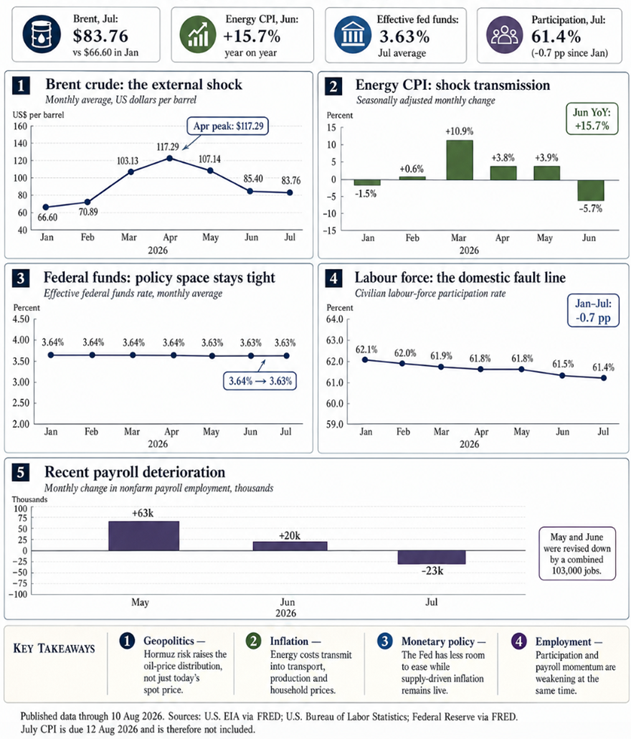
The numbers are increasingly uncomfortable. US real GDP growth slowed to an annualized 1.5 percent in the second quarter. Nonfarm payrolls fell by 23,000 in July, while employment estimates for May and June were revised downward by a combined 103,000 jobs. The unemployment rate stands at 4.1 percent, but labor-force participation has fallen to 61.4 percent. Part of the apparent resilience in unemployment therefore reflects workers leaving the labor force rather than continued strength in hiring.
Under normal circumstances, such data would strengthen the case for lower interest rates. These are not normal circumstances. Headline CPI inflation was still running at 3.5 percent year-on-year in June. The PCE price index - the Federal Reserve’s preferred inflation measure - increased by 3.7 percent, while core PCE stood at 3.3 percent. Energy prices in the CPI were 15.7 percent higher than a year earlier, with gasoline prices up 26.7 percent.
This is where the “Hormuz war” ceases to be merely a geopolitical story and becomes a monetary-policy variable. Before the conflict, roughly one-fifth of global oil and LNG flows passed through the Strait of Hormuz. Since the US-Israeli war against Iran began in late February, traffic through this critical energy artery has been severely disrupted. Brent crude briefly reached $126.41 a barrel in April. Although prices have subsequently retreated towards $84 as part of the geopolitical risk premium faded, the Strait has yet to return fully to normal operations, while Persian Gulf oil and condensate exports in July remained roughly 40 percent below pre-war levels.
The issue, therefore, is not simply today’s oil price. It is the distribution of future risks. A breakdown in negotiations, another military escalation or renewed disruption to shipping could rapidly restore a geopolitical premium to crude. In an economy where inflation has remained above the Fed’s target for years, another energy shock would not necessarily be a harmless, one-off increase in the price level. Fed Governor Lisa Cook has explicitly warned that the combination of tariffs and Middle East conflict could make inflation more persistent. FOMC discussions have similarly identified tariffs, Middle East conflict and demand pressures as interacting inflation risks. This is where the strategic error in Trump’s policy becomes clearer. The attack on Iran did not create America’s inflation problem. But it introduced an additional energy shock at perhaps the worst possible stage of the inflation cycle.
The Fault Lines
The first existing fault line is tariffs. Import duties operate as a cost shock: imported consumer goods and intermediate inputs become more expensive, leaving companies either to pass the cost on to customers or accept lower margins.
The second is fiscal policy. The federal deficit for fiscal year 2026 is projected at around $1.9tn, while recent fiscal legislation has added further pressure to the longer-term debt trajectory. Fiscal policy is therefore supporting demand at precisely the time monetary policy may need to restrain it.
The third fault line is labor supply. Lower net immigration is constraining labor-force growth. The economy can consequently experience weaker aggregate employment growth while selected industries continue to face worker shortages and wage pressure. The Congressional Budget Office has also identified lower immigration as an important factor behind weaker labor-supply growth.
Hormuz is now the fourth shock.
Together, these forces are shrinking the Federal Reserve’s policy space. The federal funds target range is currently 3.5-3.75 percent. If the Fed cuts rates in response to deteriorating employment, it risks stimulating demand while tariffs and energy costs continue to generate inflationary pressure. If it holds rates high - or tightens further - mortgage costs, corporate financing, investment and employment will face additional strain.
The more fundamental problem is that monetary policy cannot cure the origins of these shocks. Higher interest rates cannot move more oil through Hormuz. They cannot eliminate tariffs, increase immigration or reduce the federal deficit. The Fed can only suppress domestic demand sufficiently to offset inflation generated elsewhere. Put differently, the economic cost of correcting supply-side and geopolitical policy errors may have to be paid through weaker American growth and employment.
The Fed’s Dilemma
Financial markets are already pricing this dilemma. Following the weak employment report, the probability attached to a September rate increase fell from roughly 60 percent to about 45 percent. Yet the July inflation report could reverse that move quickly. A higher-than-expected CPI reading would strengthen the case for tighter policy; another deterioration in employment would intensify pressure for easing.
Does this mean an American economic earthquake is inevitable? No. But economic earthquakes rarely result from a single variable. Crises emerge when previously separate fault lines become connected and feedback loops begin to reinforce one another. Tariffs, fiscal deficits, constrained labor supply, persistent inflation, weakening employment and the Hormuz conflict are individually manageable risks. Trump’s strategic mistake was to add an avoidable geopolitical shock to this already difficult configuration, thereby reducing the Federal Reserve’s set of good policy choices.
The real danger to the US economy is therefore not a one-day surge in crude prices. It is the possibility that these fault lines begin to connect.
If the energy shock persists, inflation may keep interest rates higher for longer. Higher rates would weaken investment and employment. Slower growth would constrain tax revenues and worsen fiscal pressures. Fiscal responses could then complicate the Fed’s task still further. An economic earthquake begins when that feedback loop closes.