
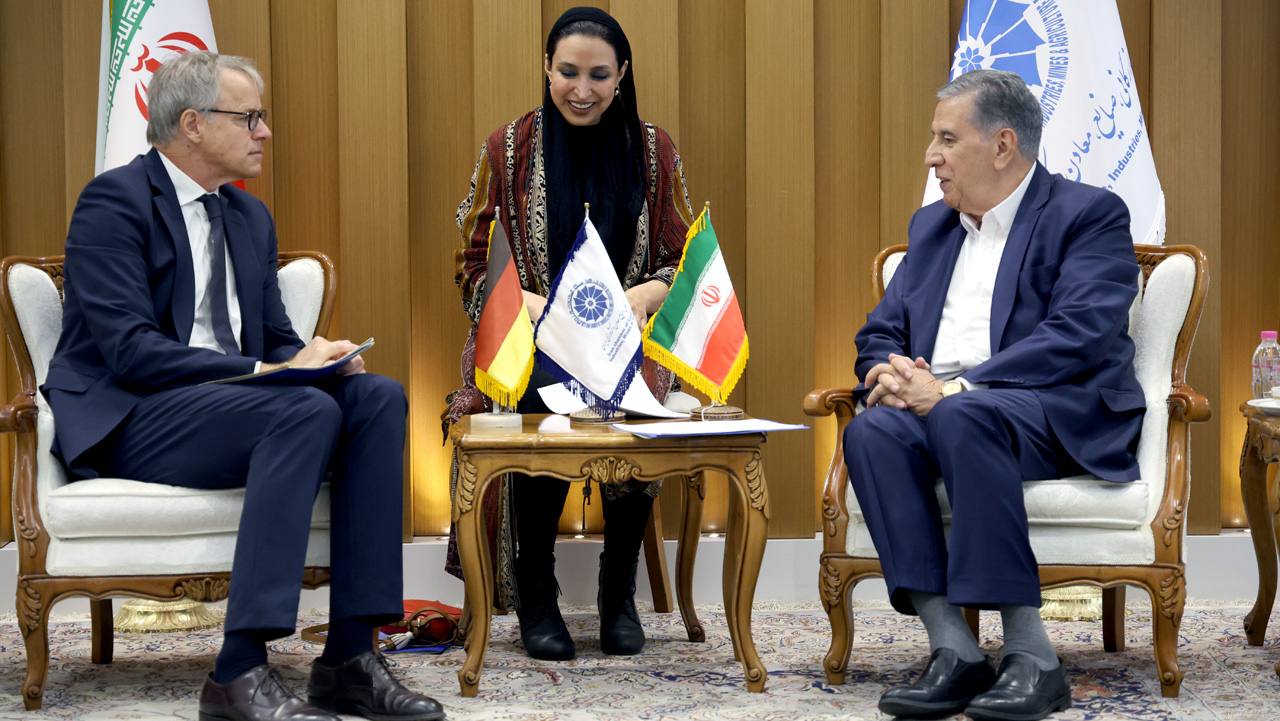
While political relations between Tehran and Berlin remain largely hostage to the broader nuclear impasse and Western sanctions architecture, economic stakeholders on both sides are testing the waters for a functional reset.
In a recent meeting, ICCIMA head Samad Hassanzadeh and newly appointed German Ambassador Axel Dittmann attempted to bridge the growing gap between historical industrial partnerships and today's stark geopolitical realities.
Hassanzadeh did not mince words regarding the erosion of bilateral economic engagement. Pointing to a "remarkable" but visibly "fading" industrial legacy—which once saw robust Iranian participation in German trade fairs and even the establishment of a German-run technical institute in Tabriz that produced many engineers—he framed the current stagnation as a strategic loss for both parties. Crucially, the ICCIMA chief positioned his chamber as a proactive intermediary, explicitly stating that joint business councils must be weaponized to boost tech transfer and trade volumes, regardless of the political weather. "Even in the most difficult circumstances, communication bridges must never be destroyed," he asserted, signaling the private sector's eagerness to decouple commerce from diplomacy.
Ambassador Dittmann acknowledged Germany's ongoing internal debate regarding over-reliance on international supply chains, noting that experts in Berlin are increasingly confident in domestic capacities for pharmaceuticals and automotive parts.
By characterizing the Islamic Republic as a country of "vast resources and a large market," he hinted that Berlin remains cognizant of Iran's long-term potential, even if short-term engagement is constrained.
Ultimately, both delegates concurred on the need for "practical operational solutions.