
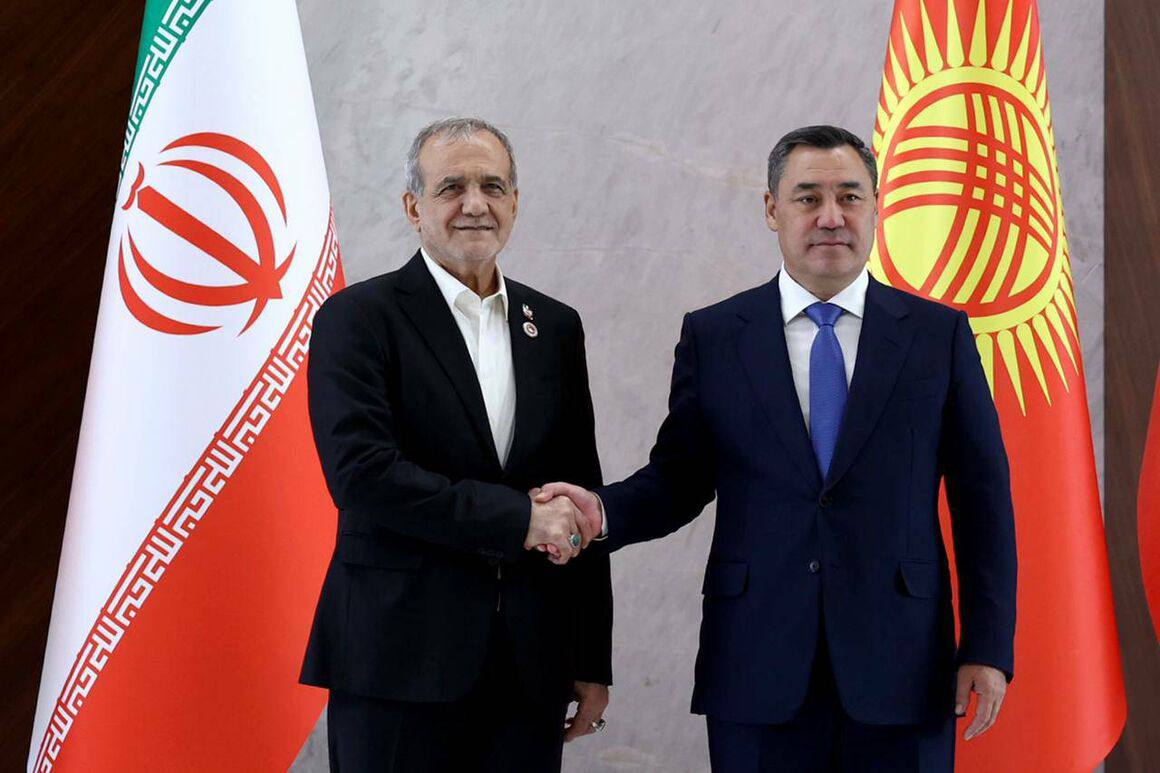
Iran and Kyrgyzstan are taking concrete steps to deepen their economic and energy partnership, with a proposed joint oil refinery in Kyrgyzstan emerging as a centerpiece of renewed bilateral engagement.
The initiative gained formal traction on Monday during the Shanghai Cooperation Organization (SCO) summit in Kyrgyzstan, where Iranian President Masoud Pezeshkian held talks with his Kyrgyz counterpart, Sadyr Japarov. Pezeshkian confirmed that Tehran has given its preliminary approval to the plan, stating that "Kyrgyzstan's proposal for the joint construction of a refinery has been reviewed positively, and Iran agrees with the principle of this proposal."
Under the envisioned arrangement, Iran would serve as the crude supplier for the facility, with the finished petroleum products to be shared between the two nations. Pezeshkian characterized the project as a strategic opportunity to elevate bilateral ties beyond conventional trade.
For resource-rich but energy-import-dependent Kyrgyzstan, the refinery could mark a turning point—offering a pathway toward greater self-sufficiency in fuel supply while opening doors to joint investment, technical cooperation, and broader industrial collaboration.
Japarov, for his part, extended a formal invitation to Iranian exploration and engineering firms, urging them to bring their technical know-how to Kyrgyzstan's oil sector. The move signals Bishkek's interest in tapping into Iran's decades of experience in petroleum operations.
Beyond the Refinery: A Broader Economic Push
The refinery discussions are just one pillar of a wider effort to revamp bilateral economic relations. In early August, Iran's Minister of Industry, Mining and Trade, Seyyed Mohammad Atabak, met with Kyrgyz Economy Minister Sydykov Bakyt Tolomushevich. The two ministers agreed to pursue joint ventures in industrial production, mining, energy, transport, and free-zone activities, with an eye toward exporting goods to third-country markets.
They also underlined the importance of regional frameworks—particularly the Eurasian Economic Union (EAEU) and the SCO—as platforms for expanding trade and investment. Cooperation in knowledge-based exports, pharmaceuticals, and medical equipment was also on the agenda.
Mining, Transit, and Financial Bridges
Kyrgyzstan's mineral wealth was another focal point, with Iran offering assistance in exploration, extraction, processing, and modernization. On the transit front, both sides prioritized the activation of the Bandar Abbas–Osh railway route, direct flights, lower transit costs, and the completion of regional corridors. Iran's position along the "Belt and Road" initiative was also flagged as a key asset for connecting Kyrgyzstan to larger markets.
To support this expanding relationship, the two countries agreed to strengthen banking and logistics infrastructure, establish a joint banking committee, promote the use of national currencies in bilateral trade, and create joint investment funds.
While many details remain to be finalized, the proposed refinery project already stands out as a potential flagship for a new chapter in Iran-Kyrgyzstan relations—one that could reshape the economic landscape between the two nations for years to come.