
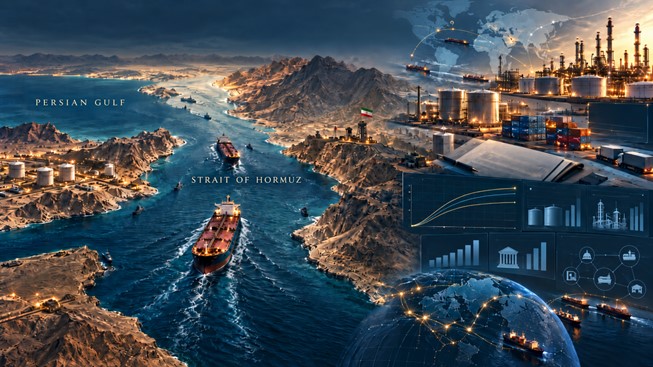
Most commentary on Hormuz begins with the same question: how high can oil go? That may be the least interesting strategic question. Oil prices capture the immediate shock; they say less about which economy can absorb higher energy costs, disrupted trade, tighter finance and uncertainty for longer without being forced to change course. In a short conflict, the ability to inflict damage matters most. In a long one, the ability to absorb damage becomes power.
Hormuz is therefore not merely an oil chokepoint. It is a stress test of national “resilience balance sheets”: energy inventories, refining and storage capacity, alternative routes, foreign-exchange reserves, fiscal space, insurance capacity and working capital. Countries with stronger resilience balance sheets are buying time—and in a war of attrition, time is a strategic asset.
China illustrates the point. Large inventories let Beijing absorb temporary supply losses, but inventories do not eliminate a shock; they move it through time. Spare capacity works the same way: extra storage or unused refining capacity may depress short-term returns, but in a crisis, they provide optionality.
There is also a less visible channel: working capital. Longer trade routes do more than raise freight costs; they lock up capital. Hormuz therefore raises not only the price of energy but the liquidity requirement of the global economy. A shock that begins as geography can migrate into corporate balance sheets, bank lending and the cost of capital.
For the United States, the more sensitive pressure point may lie in the Treasury market. With long-term yields elevated and federal debt close to $40tn, a prolonged energy shock can create a security-fiscal feedback loop: higher energy costs complicate inflation, persistent inflation delays monetary easing, higher rates increase debt-service costs, and a larger interest bill consumes fiscal room. For Washington, a short war may primarily be a military problem; a long war can become a balance-sheet problem. Europe faces a parallel constraint: every euro spent cushioning households or industry is unavailable for defense, technology or investment.
Sources of Resilience
For Iran, however, the strategic picture should not be reduced to the costs it must endure. First is geography. Iran sits at the intersection of the Persian Gulf, the Gulf of Oman, Central Asia, the Caucasus, South Asia and the wider Middle East. Second is energy depth: large oil and gas reserves, refining and petrochemical capacity, a large domestic market and long experience operating under external constraint. Third is territorial and economic depth. Iran is not a city-state dependent on a single port; its size, dispersed industrial centers, mineral resources, agriculture, energy assets and human capital provide multiple layers of resilience. Fourth is accumulated experience in adaptation. Years of restrictions on banking, insurance, shipping, trade and energy exports have imposed heavy costs, but also forced firms and institutions to develop alternative mechanisms.
Inflation, foreign-exchange vulnerability, underinvestment, banking weakness and pressure on household incomes can erode national power from within. Geography becomes strategic strength only when backed by an economy capable of buying time. If military and defense capabilities generate deterrence, bargaining leverage or strategic breathing room, economic policy must ensure those gains are not dissipated through inflation, currency instability, production bottlenecks or erosion of household purchasing power. Protecting real household incomes is therefore not merely social policy; it is part of national resilience.
The same logic reaches the corporate level. Managers must consider not only return on assets but the return on resilience. A second supplier, safety stock or additional liquidity may depress short-term returns, yet each can buy continuity when normal assumptions fail. The shift from “just in time” toward “just in case” is a repricing of that option. One might call the additional cost the geopolitical resilience premium: higher WACC, larger inventories, more expensive insurance, longer routes and greater liquidity buffers. The world is rediscovering the price of something globalization had come to treat as almost free: the ability to keep going.
For Iran, this is both a risk and an opportunity. A world that values geography, energy security, redundancy and resilience also values some of Iran’s most durable structural advantages. The challenge is to convert those advantages into lasting strength. Military and defense capabilities can buy time, deterrence and bargaining power; the economy must turn that time into durable power. In a prolonged confrontation, the winner is not necessarily the side that delivers the hardest blow. It is the side that, after absorbing the blow, still retains the freedom to choose what to do next.