
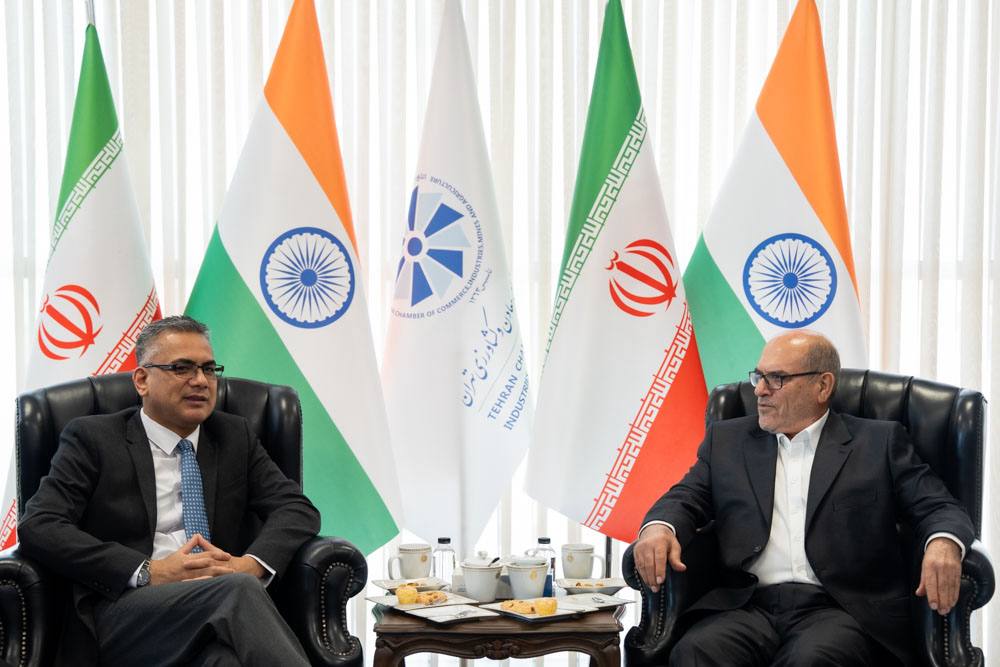
Iran and India are trying to turn a long-standing economic relationship into a more operational trade partnership, using BRICS as a fresh platform. That message emerged in Tehran this week when India’s new ambassador, Vishvash Negi, made one of his first official stops at the Tehran Chamber of Commerce, Industries, Mines and Agriculture (TCCIMA). The visit came amid efforts to restore a once-larger commercial relationship now constrained by logistical and regulatory obstacles.
Negi met TCCIMA Chairman Mahmoud Najafi-Arab, Secretary General Fereydoun Vardinejad, and Deputy for International Affairs Hesamoddin Hallaj. Also present were Foreign Ministry and embassy commercial representatives. Rather than a ceremonial courtesy call, the meeting focused on practical mechanisms: a timetable for private-sector trade talks, specialized training courses, exchange of trade delegations, and a direct communication channel to track agreements.
Najafi-Arab noted that Iran and India share deep cultural and economic ties and now both belong to BRICS. TCCIMA recently joined the BRICS Trade Council, and its representatives attended the council’s meeting in India. He said the private sectors could expand cooperation in pharmaceuticals and medicinal raw materials, food and agriculture, industrial inputs, and raw materials. Yet bilateral trade stands at only about $1.5 billion, far below potential. He urged stronger trade, joint investment, and industrial cooperation, while calling for alternative corridors and new logistics routes to ease exchanges.
Negi said expanding economic ties is a personal mission. He recalled that Iran-India trade once approached $20 billion, but has since fallen sharply. He argued that B2B meetings, direct embassy-chamber contacts, exhibition delegations, market-awareness webinars, and short-term training could rebuild momentum. He described trade with Iran as a strategic benefit for both countries.
The ambassador also pointed to multilateral opportunities. The Indian Embassy in Tehran plans a meeting soon to present BRICS achievements and 2026 programs, aiming to connect Indian companies with interested Iranian economic actors. More than 420 BRICS expert meetings and the summit’s final statement, he said, show the breadth of possible trade cooperation. The event, he suggested, could serve as a networking bridge between Indian firms and Iranian counterparts.
Vardinejad called for closer embassy-TCCIMA communication and invited Negi to Iran Expo 1405 and the opening of Iran Pharma, where Indian pharmaceutical firms will also be present. Both sides ended by stressing a scheduled, structured path for private-sector dialogue and expressing hope for stronger economic cooperation.