
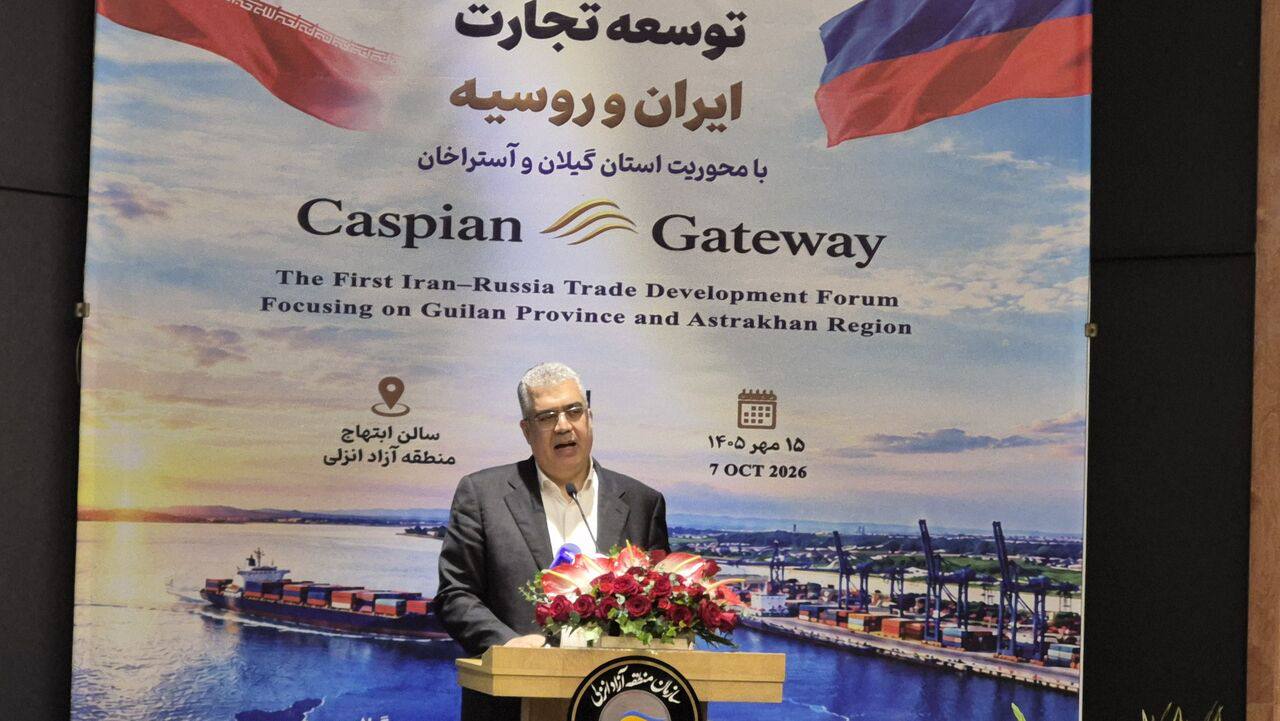
Iran’s top trade official has acknowledged that the country remains a marginal player in Russia’s roughly $300 billion annual import market, but says a new free-trade arrangement and Gilan’s logistical advantages could sharply expand non-oil exports.
Speaking at the first Iran-Russia Trade Development Summit in the Anzali Free Zone, Mohammad Ali Dehghan Dehnavi, head of Iran’s Trade Promotion Organization, said the Iran-Eurasian Economic Union free trade agreement, in force since April 2025, has removed tariffs on 87 percent of goods traded with the five-member bloc, where Russia is the largest economy. That, he argued, gives Iranian exporters a competitive edge.
The potential is substantial: studies show more than $50 billion of Russian imports overlap with goods Iran can supply. Activating that capacity, Dehghan Dehnavi said, could lift Iranian exports to Russia from the current $1–2 billion to $10–20 billion.
Gilan, he added, is well placed to lead that push. The northern province connects by sea to Russia, Kazakhstan, Azerbaijan and Turkmenistan, while road and rail links—including the border rail connection and routes via Aktau that bring Chinese goods to Anzali Port—position it as a national trade hub. Completing infrastructure and creating new opportunities for the private sector are essential, he said.
The summit, focused on Gilan and Astrakhan, brought together Iranian and Russian officials and business representatives. Panels examined obstacles to non-oil trade through Astrakhan and the role of government agencies in easing commerce.
Dehghan Dehnavi also pointed to domestic hurdles, including overlapping regulations and bureaucracy, and said Tehran is drafting a trade facilitation package and an export support package. Proposed reforms include simplifying order registration. A new trade mission linked to a Chinese province has been assigned to Gilan, with officials hoping increased exports to Russia and Eurasia will follow in the months ahead.