
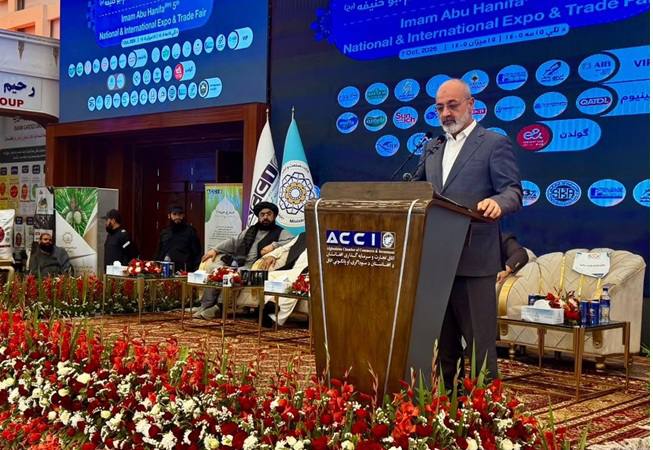
A trade delegation from the Iran Chamber of Commerce, Industries, Mines and Agriculture (ICCIMA), led by Vice President Ghadir Qiyafeh, has concluded a visit to Kabul that both sides describe as a turning point. Rather than focusing solely on exporting Iranian goods, the delegation explored joint investment, technology transfer, and the creation of production and processing chains. The trip included meetings with Nooruddin Azizi, Afghanistan’s Minister of Industry and Commerce, and Haji Akhtar Mohammad Mohammadi, First Deputy of Afghanistan’s Chamber of Agricultural and Livestock Production, as well as participation in the Fifth Abu Hanifa International Exhibition and direct B2B negotiations between Iranian and Afghan traders.
Mining Emerges as Strategic Sector
In talks with Minister Azizi, Qiyafeh pointed to Afghanistan’s vast mineral wealth and called for stronger interaction between economic actors in mining and mineral industries. Azizi welcomed expanded economic cooperation and highlighted the need for mining machinery. The meeting was attended by Hamed Asgari, ICCIMA Deputy for International Affairs; Mahmoud Omati, Vice President of the Mashhad Chamber; Hossein Beykzadeh, Vice President of the Karaj Chamber; Arash Alavi, board member of the Iran and Kerman Chamber; and Mohsen Amini, member of the Food Industry Committee and ICCIMA board. Both sides agreed that existing capacities can deepen private-sector cooperation, especially in mining.
Qiyafeh later described mining as one of the most attractive areas of Iran-Afghanistan cooperation. “Afghanistan enjoys very extensive mineral capacities, and in a correct expression, many elements of the periodic table exist in this country,” he said. Iranian companies, he added, can bring decades of experience and technical knowledge, beginning with exploration and continuing through extraction, processing, and final production. However, he stressed that developing mining and mineral industries requires infrastructure: new roads, railway lines, and power plants. Solar, hydro, wind, and thermal plants could supply the energy needed. He also noted that Afghanistan’s mineral resources are public property belonging to the Afghan people, just as mines in Iran belong to the Iranian nation. He proposed primary processing inside Afghanistan so that revenue can fund processing capacities and industrial units. Without such a value-chain approach, he warned, serious transformation in Afghanistan’s mining sector is unlikely.
Agriculture and Technology Transfer
At a separate meeting with Haji Akhtar Mohammad Mohammadi, discussions focused on agriculture, livestock, technology transfer, and production chains. Mahmoud Siyadat, President of the Iran-Afghanistan Joint Chamber, Kamaluddin Tawhid, President of the Afghanistan-Iran Joint Chamber of Commerce, Mohsen Amini, Ali Asghar Beigi, Vice President of the Yazd Chamber, Iranian parliamentarians, and members of Afghanistan’s Chamber of Agricultural and Livestock Production attended. Qiyafeh underlined Afghanistan’s need for technology and production inputs and the readiness of Iran’s private sector to cooperate. The Afghan side stressed expanding ties between the two chambers and using private-sector capacities. Siyadat proposed technical cooperation, technology transfer, and processing chains. He called for increased imports from Afghanistan, especially oilseeds, animal feed, and legumes. He also cited cooperation in pest control, industrial livestock farming, poultry, and agricultural processing, and urged greater support to activate these capacities.
Banking, Investment, and a New Economic Geography
On the sidelines of the Fifth Abu Hanifa International Exhibition, Qiyafeh told a B2B gathering that Iran must not view Afghanistan merely as a market for Iranian goods. “Our view should be toward joint investments, because joint investment can also guarantee the future of exports,” he said.
He noted the strong presence of Iranian industrial goods in electricity, energy, oil, petrochemicals, and conversion industries, but identified financial, monetary, and banking exchanges as a major obstacle. He expressed hope that an Iranian bank branch or representation could open in Kabul and an Afghan bank branch in Iran. He also highlighted Afghanistan’s processing and conversion industries, especially agricultural conversion, and the development of its steel industry as areas for technical and industrial cooperation. More than 10 Iranian groups at the exhibition were interested in investing, some in conversion industries.
Siyadat said Afghanistan’s security and industrial growth have created conditions for a new phase of economic partnerships. He praised the presence of Foreign Ministry and parliamentary representatives and said the joint chambers are ready to cooperate “as wings of flight.” He described the deep affinity between the two peoples and hoped the exhibition would begin a season of deeper, broader, and more lasting cooperation.
Iran’s Ambassador in Kabul, Alireza Beykdeli, said traders bring the two brotherly peoples closer. Over the past two years, he said, the concept of economic cooperation has transformed: questions once focused on visas, border containers, and company access; today, business leaders discuss a crude oil pipeline to Afghanistan, a refinery, the Herat-Mazar-e-Sharif road, and factory construction. “Good days await Iran-Afghanistan relations,” he said.
At the exhibition opening, Qiyafeh said the presence of economic actors shows Afghanistan can be at the center of regional economic cooperation. “An exhibition is not only a place for offering and introducing products; sometimes it can be a place where a new economic geography takes shape,” he said. Political geography is fixed, he added, but economic geography can be built together. Borders can become trade routes, and neighborliness can become partnership. With Afghan and Iranian investors working together, he concluded, next year’s exhibition could witness investments coming to fruition and new horizons opening.
Based on these meetings, Iran-Afghanistan relations are no longer limited to exchanging goods. Both sides now emphasize joint investment, technology transfer, production and processing chains, removal of banking obstacles, and turning neighborliness into economic partnership. If realized, the Abu Hanifa Exhibition may mark the starting point of a new economic geography and more durable private-sector cooperation.