
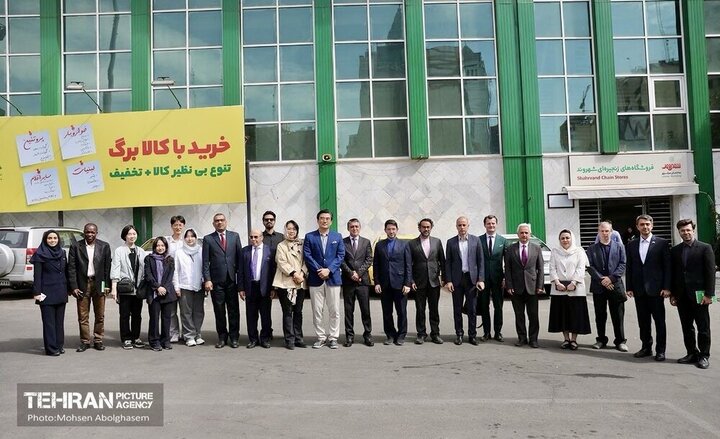
In a move that signals Tehran's will to position itself as a regional hub for urban innovation and food security, the city hosted a delegation of foreign ambassadors, international organizations, and economic representatives for a specialized tour of its urban market infrastructure. The half-day program, held on Saturday, October 10, was the first in a series titled "Introducing Tehran's Urban Management Capabilities," organized by Tehran Municipality's Communication and International Affairs Center in cooperation with the Economic Cooperation Organization (ECO) and the Asian Mayors Forum (AMF).
The initiative reflects a broader strategy by Tehran's municipal leadership to transform traditional sister-city relationships into tangible economic partnerships, using the city's extensive food distribution network as a showcase for its administrative and logistical expertise.
A City That Feeds Itself
At the heart of the tour was the Jalal Al-e Ahmad Fruit and Vegetable Market, one of approximately 320 such markets operating across the capital. There, Mehdi Bakhtiari-Zadeh, CEO of the Organization for Management of Fruit and Vegetable Markets, painted a compelling picture of a city that has built one of the region's most sophisticated food supply systems.
"Access to high-quality, healthy, and reasonably priced food products is one of the main axes of the municipality's activity," Bakhtiari-Zadeh told the visiting delegation. He noted that Tehran's market network supplies roughly 53 percent of the capital's food needs, with prices typically 30 to 45 percent lower than city-level averages. More than two million tons of fresh and processed food products pass through this network annually.
The statistics underscore a remarkable achievement in urban management: citizens can access one of the municipality's food distribution centers by traveling less than 900 meters on average. Quality control mechanisms, including direct supply chains and continuous testing, ensure that products failing to meet health and quality standards are barred from entering the network.
Bakhtiari-Zadeh expressed readiness to share this expertise with interested countries, particularly in the areas of technical knowledge transfer, food supply management, and export development. "Cooperation with traders and economic actors can provide the basis for developing the export of fruit and vegetable products and protein products," he said, noting that agricultural trade between Iran and several participating countries already exists.
Shahrvand: A Platform for Global Exchange
The delegation then visited the Beihaghi branch of Shahrvand, Iran's largest chain store, where CEO Davood Qorbanian welcomed the guests and outlined ambitious plans for international collaboration. Qorbanian, who also serves as vice chairman of the country's Chain Stores Union, emphasized that cooperation could extend well beyond food supply.
"The areas of cooperation are not limited only to the supply of food, agricultural products, and meat; they also include the field of retail technologies, including enterprise resource planning software, store management, and marketing systems," he said.
Qorbanian invited foreign companies to introduce capable firms from their countries for joint ventures, positioning Shahrvand as a potential gateway for international products seeking access to Iran's substantial consumer market. "Iranian producers and industries can use the capacity of Shahrvand stores to offer products, introduce brands, and access the consumer market," he noted. "In return, this company can be a platform for introducing and offering products of various countries in the Iranian market."
The program concluded with a press conference and a specialized meeting where Hamid Reza Gholamzadeh, Secretary-General of the Asian Mayors Forum, highlighted Tehran's "Zero Inflation" initiative, a municipal program aimed at stabilizing the prices of 12 essential goods over six months.
He stressed the importance of leveraging city-to-city relations to develop commercial cooperation, transfer experiences, and engage economic companies in joint ventures.
Emre Hengut, Deputy Secretary-General of ECO, praised Tehran's experience in food supply and distribution, emphasizing the role of municipalities in strengthening food security and ensuring affordable access to essential goods, even in crisis conditions. He called for continued specialized visits and experience exchange among regional cities and institutions.
A Model for Regional Cooperation
The delegation included ambassadors and diplomats from South Korea, Lebanon, Sudan, Tajikistan, Burkina Faso, Russia, Poland, Oman, and Pakistan, as well as representatives from the United Nations and ECO. Their presence signals growing international interest in Tehran's approach to urban management and food security—issues that have become increasingly critical as cities worldwide grapple with supply chain disruptions and rising food prices.
If followed by concrete agreements and sustained follow-up, such initiatives could help transform Tehran's international relationships into tangible economic partnerships, enhance regional food security, and open new export and knowledge-exchange opportunities for both Iran and participating countries. For a city often portrayed through the lens of geopolitical tensions, the visit offered a different narrative: Tehran as a capable, willing partner in addressing some of the region's most pressing challenges.
The specialized visit was not merely a showcase—it was an invitation. Whether that invitation is accepted will depend on the willingness of all parties to move from diplomatic gestures to practical collaboration.