
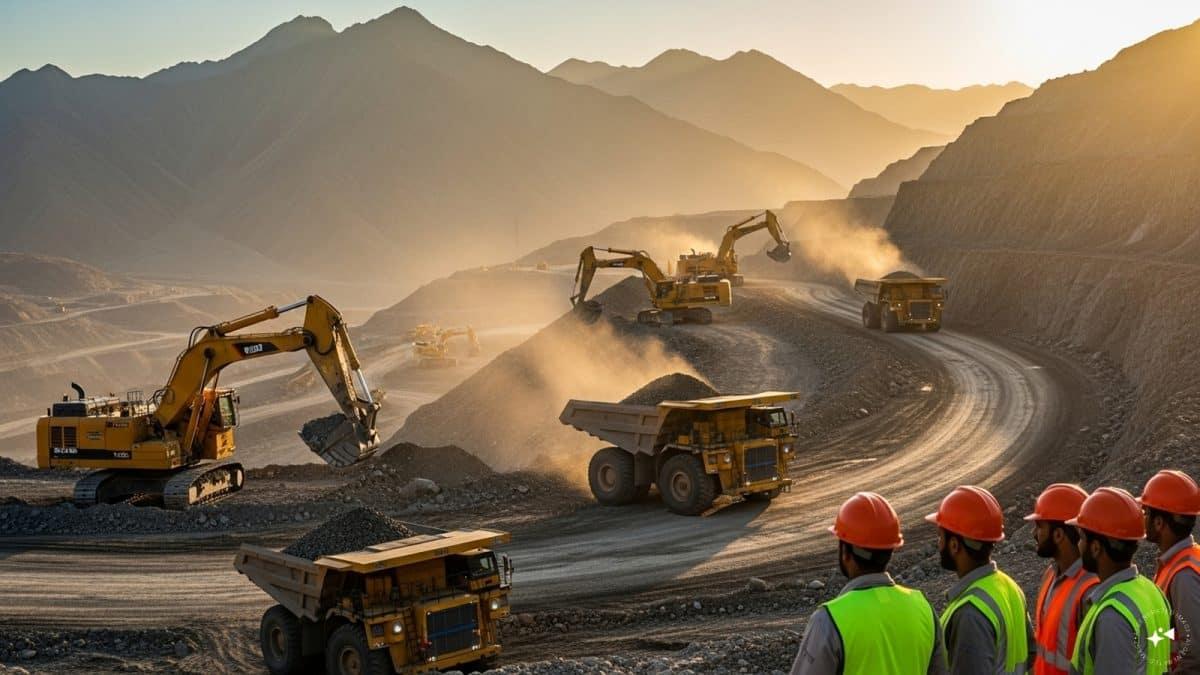
Iran and Pakistan are broadening their economic engagement, with mining emerging as a strategic sector in their push to reach $10 billion in bilateral trade by 2030. In the latest high-level exchange, Mohammad Ali Dehghan Dehnavi, head of Iran’s Trade Promotion Organization (TPO), met Asad Ahmad, CEO of the Pakistan Mineral Development Corporation, to discuss ways to deepen commercial ties and unlock mineral-sector cooperation.
The meeting focused on expanding trade and economic relations, creating new opportunities for economic interaction, and using existing capacities to strengthen bilateral cooperation in mining. Both officials exchanged views on practical frameworks for trade exchanges and called for greater use of shared opportunities. Dehghan Dehnavi reaffirmed the TPO’s readiness to support expanded trade with Pakistan and stressed the importance of stronger ties across multiple commercial fields. Ahmad welcomed the prospect of new cooperation and new capacities for bilateral trade.
The talks build on a series of diplomatic and commercial engagements. In early August, the two countries signed a memorandum of understanding during the 10th session of the Joint Trade Committee in Islamabad. The MOU was signed after talks attended by Iran’s Minister of Industry, Mining and Trade, Seyyed Mohammad Atabak, and Pakistan’s Commerce Minister, Jam Kamal Khan. It covered joint border regions, maritime and shipping development, steps toward a free trade agreement, joint free zones, and barter trade mechanisms.
At the signing ceremony, Atabak called the negotiations constructive and said Iran imposes no restrictions on increasing trade with Pakistan. He urged the private sectors of both countries to play a larger role, echoing Tehran’s policy of expanding cooperation with neighbors. A separate cooperation memorandum between the Iran Chamber of Commerce and Industries and the Federation of Pakistan Chambers of Commerce and Industry further institutionalized private-sector engagement.
Dehghan Dehnavi, addressing traders and economic activists from both sides, outlined Iran’s strategic vision. He said trade and economic relations with neighboring and aligned countries are a top priority, and described Pakistan as a friendly neighbor with strong political and economic importance for Iran. He highlighted Iran’s 90-million population, energy resources, mining and industrial capacity, technical and engineering services, and strategic location linking rail, road, and international shipping networks. Iran’s ports on the Caspian Sea, the Persian Gulf, and the Indian Ocean—especially Chabahar—were presented as key nodes for regional connectivity. He also expressed willingness to use Karachi and Gwadar to expand international interactions.
The mining discussions fit that broader agenda. Iran’s mineral and industrial base, paired with Pakistan’s developing mineral sector, offers potential for joint ventures and knowledge transfer. Trade volume in 2025 stood at about $3 billion. Reaching $10 billion by 2030 will require removing transport and customs bottlenecks, easing financial-transfer and banking barriers, and upgrading border infrastructure. Participation in exhibitions and exchanges of trade delegations would also help bring the private sectors closer.
For Islamabad, the partnership offers access to Iranian energy, engineering services and transit routes. For Tehran, Pakistan represents a gateway to South Asia and beyond. The mining memorandum is not yet a done deal, but it gives both sides a concrete sector to test cooperation.
A large Iranian trade delegation accompanied officials, with representatives from oil, gas, petrochemicals, food, agriculture, transportation, shipping, and knowledge-based industries. With the MOU signed and implementation mechanisms under development, both governments appear intent on turning long-standing neighborly ties into measurable economic gains for nearly 300 million people.
The TPO-Pakistan Mineral Development Corporation talks signal that mining—long overshadowed by energy and border commerce—could become a new pillar of that partnership.