
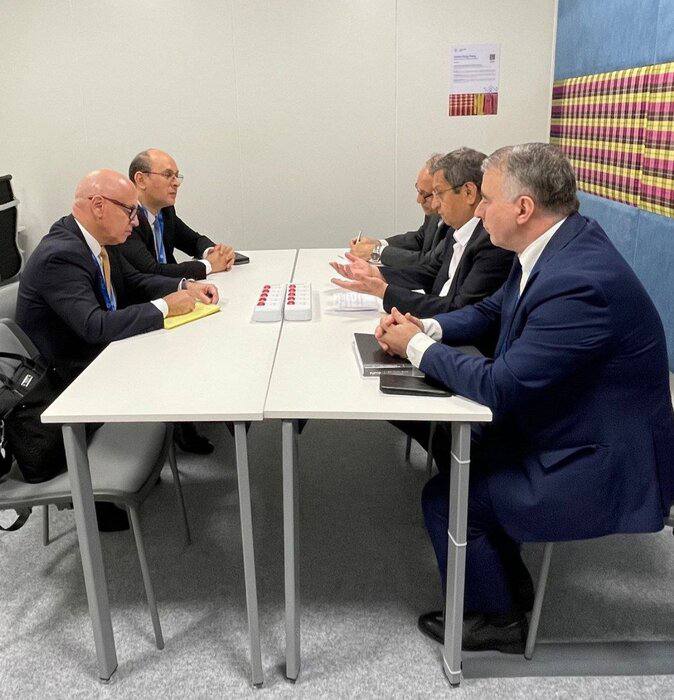
As policymakers gathered for the International Monetary Fund’s annual meeting, the governors of the Iranian and Algerian central banks used the sidelines to push for closer monetary, banking and trade relations, according to Iranian media reports.
Abdolnaser Hemmati, Governor of the Central Bank of Iran, met Mohand Bouri, Governor of the Central Bank of Algeria, to review the latest state of bilateral economic ties. Both sides discussed ways to raise the level of joint economic cooperation and to draw on each other’s capacities to strengthen trade interactions.
The Iranian governor pointed to the historical and political commonalities between the two countries and stressed Tehran’s serious determination to develop and consolidate economic relations with friendly and brotherly states. Bouri, for his part, expressed satisfaction with the meeting and underlined Algeria’s readiness to expand economic and banking cooperation with Iran, while calling for mutual agreements to be followed up in the interests of both nations.
The meeting comes against a backdrop of growing interest in Algeria as an economic partner. In late December, Saeed Zare’ Haghighi, head of Iran’s Trade Center in Algeria, described the North African country as a largely untapped market whose infrastructure needs offer significant opportunities for exporting technical and engineering services.
He argued that Africa — and Algeria in particular — should be viewed as a strategic destination for Iran’s private sector, noting that the limited number of commercial counsellors makes targeted entry into new markets essential.
Zare’ Haghighi described Algeria as geopolitically secure and strategically located close to Europe. After the decline in Russian energy exports, about 20 percent of Europe’s oil and gas is now supplied by Algeria, he said. He also noted that Algeria’s foreign-currency revenues had risen from around $50 billion to more than $300 billion in recent years, generating a trade surplus of $20 billion to $30 billion and creating broad scope for economic cooperation.
Algeria, he added, has strong demand for technical and engineering services, infrastructure projects, and the construction of silos and storage facilities linked to food security — areas where Iranian companies have technical know-how and experience. He also highlighted the country’s industrial and mining potential, including steel and phosphate, and said the trade center was ready to identify opportunities, guide exporters and promote participation in specialized exhibitions, drawing on models used by countries such as Turkey that combine trade with on-the-ground investment.