
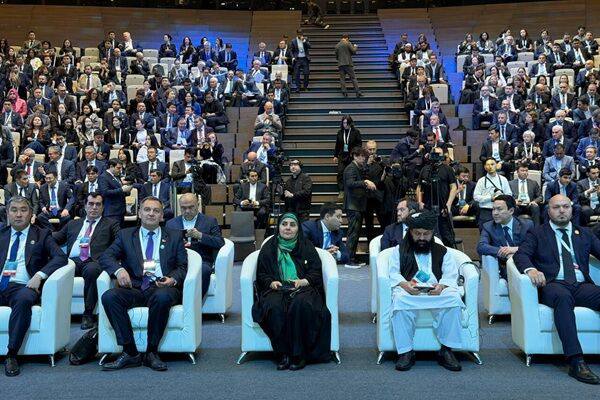
Iran’s transport minister used a three-day visit to Kazakhstan to push a vision of regional connectivity that hinges on unlocking Central Asia’s access to open waters through Iranian territory. Farzaneh Sadegh, minister of transport and urban development, led a delegation to Astana from October 14-16, combining bilateral talks with participation in the 14th ECO transport ministers’ meeting and the “New Silk Road” business forum.
The centerpiece was the North-South Corridor’s eastern branch, a route linking Russia and Kazakhstan to Iran and onward to the Indian Ocean. Sadegh said a roadmap drafted by Iran, Kazakhstan, Russia, and Turkmenistan had been sent to the Kazakh side for signing “at the earliest opportunity.” She also promoted the China-Kazakhstan-Iran-Europe route and called for removing tariff, customs, and operational barriers on the Almaty-Tehran-Istanbul rail line.
In bilateral talks with Kazakh Transport Minister Nurlan Sauranbayev, the two sides agreed to draft a comprehensive transport and logistics cooperation document. They also discussed increasing road fleet permits and drivers’ stay duration—practical issues that affect cargo schedules and costs. Specialized working groups will be formed to finalize details.
Chabahar featured prominently. Sadegh described the 628-kilometer Chabahar-Zahedan railway, which connects the southern port to Iran’s national rail network, as a gateway for Afghanistan and landlocked Central Asian states. She invited her Kazakh counterpart to the railway’s opening ceremony and highlighted the Chabahar transit agreement with Afghanistan and India.
At the ECO meeting, Sadegh called for operational, time-bound plans rather than general agreements. She proposed a joint action plan with clear national responsibilities and progress reports at the next meeting. She also asked the ECO Secretariat to study security disruptions’ effects on regional corridors and propose resilience measures.
Digitalization was another theme. Sadegh argued that physical infrastructure must be paired with regional digital platforms to simplify transit, cut border delays, and reduce costs. Iran’s railway CEO, Jabbarali Zakeri, noted Kazakhstan’s success in cutting railcar border crossing times to about 30 minutes through paperless exchanges.
Sadegh also met Uzbekistan’s transport minister, Ilhom Mahkamov, to discuss fuel price differentials, border problems, and fleet acceptance. Both sides agreed to form working groups.
Notably, no new contracts or memoranda were definitively reported. The announced outcomes were agreements to follow up on roadmaps, finalize documents, form working groups, and examine obstacles. The trip’s key real test will be whether these processes yield signed documents and genuine measurable gains in transit capacity over the coming months.